feature · anime
Vampire Hunter D Watch and Reading Order — Where to Start Before Bloodlust Returns to Theaters
The 1985 film and Bloodlust aren't one tight continuity, and the light novels split off further still. Here's the actual relationship between them, and where to start depending on whether you're watching or reading.
 By Kenza Benouna6 min read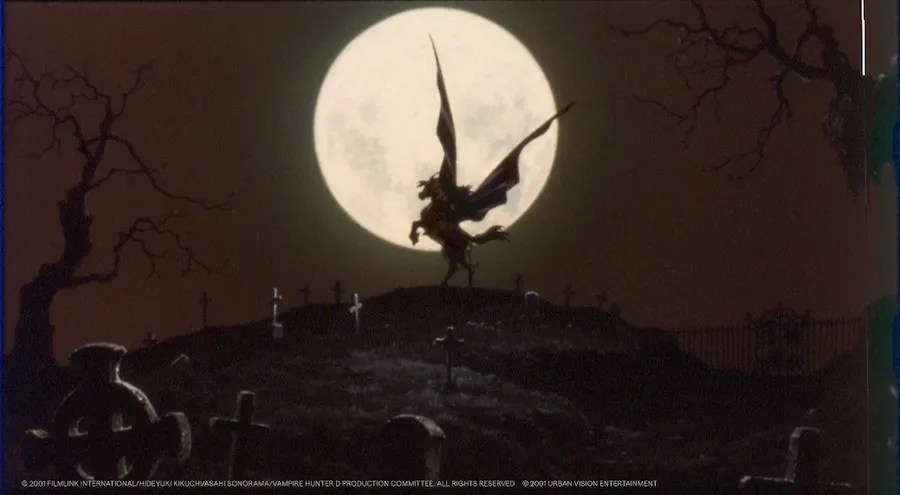
Two animated films share a hero named D. They do not share a continuity, a cast, or even a consistent design for the character himself — and Vampire Hunter D’s light novels branch off from both of them into a separate, much larger story. With GKIDS bringing Bloodlust back to North American theaters and the 1985 original having already had its own 40th-anniversary return, here’s how the films actually relate, and the most sensible way into the franchise depending on whether you want to watch or read.
The Two Films Are Not One Continuity
Start here, because it’s the single most common assumption to get wrong: Vampire Hunter D (1985) and Vampire Hunter D: Bloodlust (2000) are not sequential chapters of one serialized story. They share a title, a protagonist, and a source author, and nothing else is guaranteed to carry over.
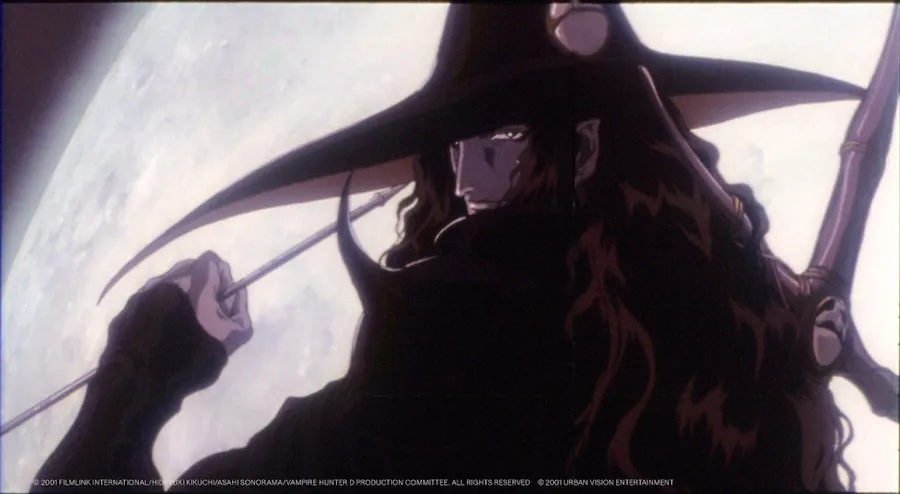
The clearest evidence is D himself. He’s voiced by different actors in both languages across the two films — Kaneto Shiozawa played him in Japanese in 1985, replaced by Hideyuki Tanaka for Bloodlust, with the same split on the English dub side. His design changed too: Bloodlust redesigned the character, with illustrator Yoshitaka Amano credited on the later film. Different directors made each one — Toyoo Ashida directed the 1985 film, while Yoshiaki Kawajiri, working at Madhouse, directed and wrote Bloodlust.
They also draw from different points in the source novels. The 1985 film adapts Hideyuki Kikuchi’s original 1983 novel, the first in the series. Bloodlust is based on the third novel, D — Demon Deathchase. Nothing about D’s past, his relationships, or the state of the world in one film is treated as binding on the other — each is its own self-contained adaptation of a different book, using the same basic premise (a near-immortal dhampir hunter for hire in a far-future, post-collapse world where vampire nobility still rule).
Bloodlust exists in the first place because Kikuchi reportedly wasn’t happy with how limited the 1985 film’s budget made it look, and pushed for a better-resourced follow-up once fan demand was there. That’s a response to the earlier film’s reception, not a continuation of its plot.
What “Bloodlust” Is About
Bloodlust follows D taking a job to track down Charlotte, a young woman apparently abducted by the vampire nobleman Meier Link — except D isn’t the only hunter on the case, and the other bounty hunters chasing the same job complicate what looks at first like a straightforward rescue. It premiered at the Fantasia International Film Festival in 2000.
Critical reception has consistently treated it as approachable without the 1985 film as a prerequisite — reviewers have specifically noted that newcomers unfamiliar with the earlier film can follow and enjoy Bloodlust on its own, even if longtime fans get a bit more out of recognizing D’s carried-over premise. You do not need to watch the 1985 film first to understand Bloodlust.
What the 1985 Film Is About
The original film is set in the year 12,090 AD, in a post-nuclear-holocaust world where vampire nobility still hold territorial power over scattered human settlements. Teenage Doris Lang is attacked and bitten by the vampire lord Count Magnus Lee while patrolling her family’s land, and hires D — a wandering dhampir hunter — to protect her and her younger brother before the Count’s bite fully claims her.
It’s rougher and more overtly gothic-horror than Bloodlust’s more polished, higher-budget follow-up, and it’s the film most likely to feel dated to viewers coming in cold. That’s not a knock on watching it — it’s simply useful to know going in what to expect stylistically, since it was made 15 years earlier on a noticeably smaller budget.
Do You Need to Watch Them in Order?
No — and “in order” barely applies here, since they aren’t telling one story. If you only watch one, Bloodlust is the more commonly recommended entry point: better resourced, more polished, and explicitly not written to require the earlier film. If you want the fuller picture of how the character and franchise evolved, watching 1985 first gives useful context for how much Bloodlust changed, but it’s a “nice to have” rather than a requirement.
Anime-only viewers, condensed recommendation: Watch Bloodlust first if you only want one film. Go back to the 1985 original afterward if you’re curious about the character’s earlier, rougher incarnation — treat it as a companion piece, not a prequel you need for context.
The Light Novels Are Their Own, Much Bigger Story
Both films are adaptations of specific individual novels within a much longer prose series by Hideyuki Kikuchi, and the novels are not limited to what either film covers. English translations, handled by Dark Horse (with Digital Manga Publishing also involved early on) and translator Kevin Leahy, began in May 2005, and the series has continued releasing since — with English volume numbering that doesn’t map cleanly onto the original Japanese numbering, since some multi-part Japanese stories were split across multiple English volumes. Dark Horse began reissuing the earlier volumes as omnibus editions in 2021, collecting three original volumes per omnibus.
Best route for readers: Start at Volume 1, the same novel the 1985 film adapts, rather than jumping to Volume 3 (Demon Deathchase, the Bloodlust source) — the films are standalone adaptations, but the novels are a continuous prose series where later books build on earlier ones in a way the films don’t require of each other. If Dark Horse’s 2021 omnibus editions are in print for the volume you want, they’re a straightforward way to get three books’ worth of story in one release.
Can You Watch Bloodlust Without Reading the Novels First?
Yes. Both films work as fully self-contained viewing experiences — you don’t need any novel-reading homework to understand either one. The novels reward readers with a far more expansive version of D’s world than either film has room for, but they’re a separate, optional deep dive rather than a prerequisite.
Where Things Stand for Bloodlust’s Theatrical Return
For the specifics of GKIDS’ 2026 rights acquisition, the New HD Master planned for a wider 2027 theatrical and home entertainment release, and the separate fall 2026 Japanese-language-with-subtitles theatrical screenings (dates and cities still to be announced), see our full report on Bloodlust’s GKIDS theatrical return — that acquisition is specific to Bloodlust, not a reissue of the 1985 film, which already had its own separate 40th-anniversary North American theatrical run in 2025.
The Short Version
- Vampire Hunter D (1985) and Bloodlust (2000) are standalone films, not sequential chapters — different directors, different voice casts, different novels as source material.
- You don’t need to watch 1985 before Bloodlust, and most critics treat Bloodlust as the more accessible entry point.
- The light novels are a separate, continuous prose series; start at Volume 1 if you want to read in the order the story actually builds.
- Neither film requires reading the novels, and the novels aren’t required to enjoy either film.
Sources
Related coverage
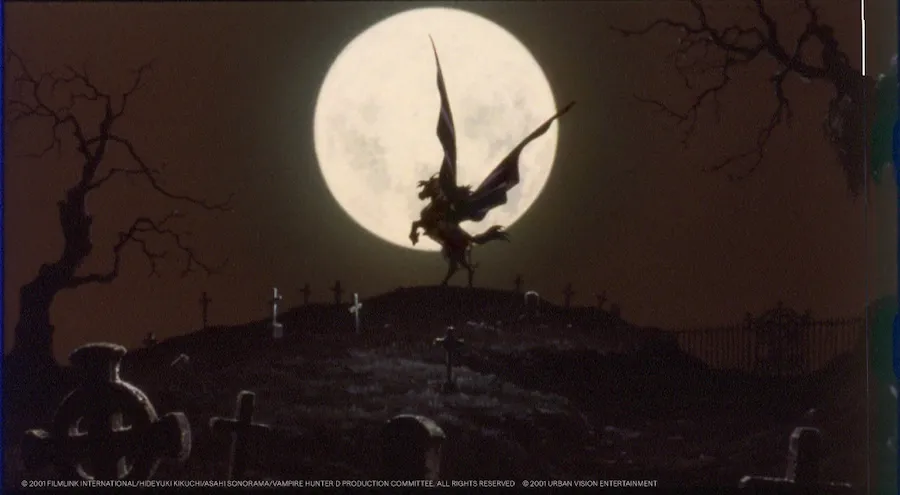
Vampire Hunter D: Bloodlust Returns to North American Theaters in 2027 via GKIDS
GKIDS has acquired Vampire Hunter D: Bloodlust and will bring its Japanese-language version to select North American theaters this fall before a wider 2027 release.

Look Back Beginner Guide — From Tatsuki Fujimoto's Manga to the Anime and Hirokazu Kore-eda's Live-Action Film
Tatsuki Fujimoto's one-shot Look Back now exists as manga, a 2024 anime film, and a 2026 live-action adaptation from Hirokazu Kore-eda. Here's how the three versions relate and where to start.
Godzilla Minus Zero Trailer Breakdown: What's Confirmed, the New Extermination Plan and That Mystery Roar
TOHO and GKIDS' full trailer for Godzilla Minus Zero confirms Godzilla survived and a new extermination operation. Here's what's actually confirmed, what's just shown in the footage, and what's still speculation.
Best Anime for New Viewers: 7 Easy Places to Start
Choose your first anime by the kind of story, tone and time commitment you already enjoy, from a short thriller to a long fantasy adventure.
About the author
Kenza Benouna
Movies, TV & Horror Writer
Kenza Benouna writes about movies and television, with a substantial archive in horror. Her Red Reactions work includes reviews, supernatural and franchise lore, story explainers and analysis of character, atmosphere and adaptation.
Coverage: Horror · Movies · TV · Reviews · Lore & Features
More from Kenza Benouna