lore · tv
The Demogorgon Explained: Every Form, the Hive Mind and How Stranger Things 5 Changed the Monster
What the Demogorgon actually is in Stranger Things: its life cycle, its link to Vecna's hive mind, and how Season 5 turned the monster into a weapon.
 By Aram Anwar4 min read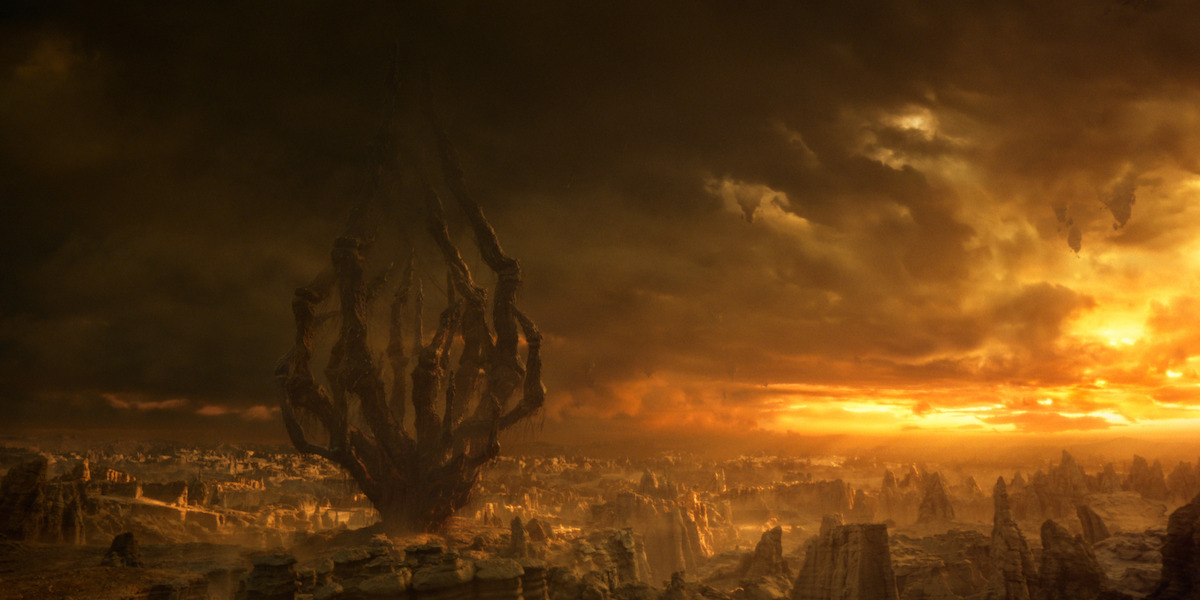
The Demogorgon was Stranger Things’ first monster, and for most of the show’s run it was treated as exactly that: a faceless predator with a flower for a head. Five seasons later, the creature sits inside a much larger mythology involving the Abyss, Vecna’s hive mind and, in the final season, a boy who learned to turn the monsters against their master. This explainer gathers the whole picture, from the 1983 attack on Will Byers to what Season 5 finally revealed.
If you want the broader cosmology first, start with our breakdowns of the Upside Down and Vecna himself; this piece focuses on the creatures.
What a Demogorgon actually is
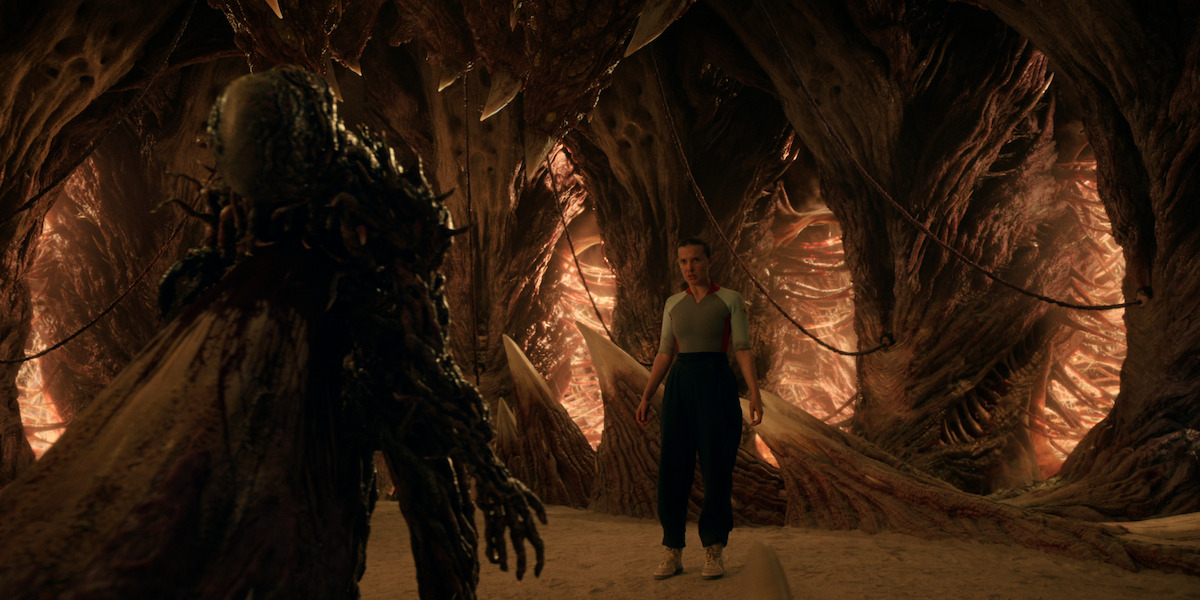
The name is borrowed, not native. The kids christened the creature after the demon prince from their Dungeons & Dragons campaign, and the label stuck to the whole species. In-world, Demogorgons are predators native to the Abyss, the hostile alien dimension revealed properly in Season 5: a landscape of jagged rock and storm-yellow sky that Netflix identifies as the home of the Mind Flayer, the vines and the Demogorgons alike. The Upside Down, for all its menace, was only ever the bridge those creatures crossed.
Physically, the adult is defined by its head, which splits open into five petal-like flaps lined with teeth, and by its ability to pass between dimensions through temporary, membrane-like wounds in reality. It hunts by blood. A few drops drew the original creature across worlds in Season 1, a rule the show has kept consistent ever since.
The life cycle, from slug to soldier
Season 2 laid out the species’ stages through Dustin’s doomed pet. A Demogorgon begins as a slug-like larva of the kind Will coughed up after his rescue, grows through a juvenile stage, the “Demodog” that Dustin named D’Artagnan, and matures into the bipedal adult. Season 4 added the winged cousins, the Demobats that swarm the Upside Down’s skies and guard Vecna’s lair.
The crucial fact uniting every stage: none of them is independent. They are limbs.
The hive mind: whose hands these really are
Season 4 reframed the entire bestiary. In his lair, Vecna tells Eleven that after his banishment he found a cloud of particles and gave it form, the giant spider entity the kids call the Mind Flayer. On the show’s own account, the Mind Flayer is Henry Creel’s creation and instrument, and the Demogorgons are, in effect, his hands.
The connection is literal and bidirectional. Vecna sees through Demogorgons and directs them across worlds, but the network can be attacked from either end: when Joyce and Hopper kill the captive Demogorgons in the Russian prison, and the Creel House trio burn Vecna’s body, creatures on the other side of the planet visibly weaken. That both-ways wiring is the single most important rule the show established about the monsters, because Season 5 is built on it.
What Stranger Things 5 changed
The final season retroactively sharpened the Demogorgon’s place in the story. The Season 1 attack on Will Byers was never random: Vecna claims Will as his first vessel, the boy who taught him he could channel his thoughts through a human host. The creature that took Will was running an errand.
Season 5 also returned the monsters to active duty. A Demogorgon snatches Holly Wheeler from the Wheeler house in Episode 2, the abduction that drives much of the season, and the creatures mass into something the show had never staged before: an army.
Then comes the reversal. At the end of Episode 4, cornered by that army and goaded past breaking point by Vecna, Will Byers reaches into the hive-mind connection he has carried since Season 1 and takes the creatures down himself. Ross Duffer has described the season’s premise in exactly those terms: what happens if Will can harness the connection and turn it against the villain. The species that opened the series by abducting Will ends it answering to him.
Every major Demogorgon moment, in order
- 1983, Season 1: Eleven’s lab contact with the creature tears the first gate; the Demogorgon takes Will and kills Barb before Eleven destroys it.
- 1984, Season 2: the larva-to-Demodog life cycle plays out through D’Artagnan; packs of juveniles serve the Mind Flayer’s assault on Hawkins Lab.
- 1985, Season 3: the species sits out the Starcourt fight, but a captive Demogorgon appears in Russia in the season’s final scene.
- 1986, Season 4: the Russian Demogorgon becomes a prison executioner; Demobats guard Vecna’s lair and kill Eddie Munson.
- 1987, Season 5: Demogorgons operate openly in Hawkins as Vecna’s soldiers, abduct Holly, and are finally turned against their master through Will.
The Demogorgon’s arc is the show’s thesis in miniature. What looked like a wild animal in 1983 was an instrument all along, and the question of the finale was never how to kill the monster, but who gets to hold the leash.
Sources
Make Red Reactions a preferred source
Choose Red Reactions as a preferred source in Google Search.
Confirm your choice on Google.
Related coverage
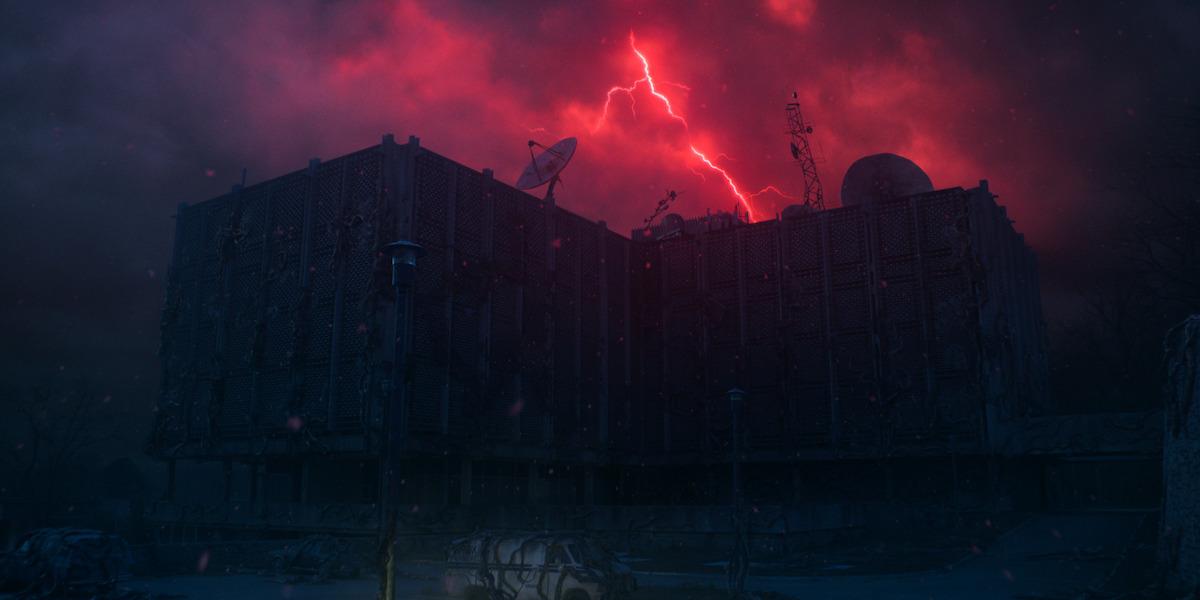
The Upside Down Explained: What Stranger Things 5 Finally Revealed
Stranger Things 5 rewrote our understanding of the Upside Down. Here is how the wormhole, the Abyss, Eleven, Vecna and the frozen 1983 Hawkins copy actually connect.
Eleven Explained: Jane Hopper's Full Story, Powers and What the Ending Means
Who Eleven really is, where her powers actually come from, and what Stranger Things 5 decided to do with her at the end — Jane Ives, Jane Hopper, Number Eleven, all of it.
Vecna Explained: Henry Creel, Powers, the Mind Flayer and His Full Stranger Things History
Who Vecna really is, how Henry Creel became One, what Stranger Things 5 changed about the Mind Flayer, and how the story of Hawkins' villain actually ends.

Stranger Things: Tales From '85 Season 2: Release Date, Story and Where It Fits in the Timeline
Stranger Things: Tales From '85 Season 2 premieres September 17, 2026 on Netflix. Here's what the animated series actually is, where it picks up, who's returning, and when it takes place in the Stranger Things timeline.
About the author
Aram Anwar
Founder & Editor
Aram Anwar founded Red Reactions and writes across comics, gaming, movies and television. His work includes franchise guides and large Lore / Explained features, with an emphasis on separating confirmed details from reports, theory and speculation.
Coverage: Comics · DC & Marvel · Gaming · Movies & TV · Lore / Explained · Guides
More from Aram Anwar