lore · tv
Vecna Explained: Henry Creel, Powers, the Mind Flayer and His Full Stranger Things History
Who Vecna really is, how Henry Creel became One, what Stranger Things 5 changed about the Mind Flayer, and how the story of Hawkins' villain actually ends.
 By Aram Anwar23 min read
Spoiler warning: this article covers the complete Stranger Things series, including every episode of Season 5 and the finale, “Chapter Eight: The Rightside Up”. If you have not finished the show, stop here.
Vecna arrived in Season 4 as the first Stranger Things villain who could talk back. He had a name, a face, a history and a philosophy, and for two years the working assumption was straightforward: Henry Creel was the author of everything, the man who found a cloud of particles in the Upside Down and moulded it into the Mind Flayer.
Season 5 does not erase what Season 4 showed, but it changes what that scene means. The final season goes back further than Hawkins, further than the lab, to a cave in the Nevada desert and an eight-year-old boy — and then deliberately refuses to tell us exactly who has been in control ever since.
Who is Vecna?
Henry Creel, One and Vecna are the same person. The names mark three phases of one life, and a fourth — Mr. Whatsit — is added in Season 5 as a disguise rather than an identity.
- Henry Creel is his birth name, covering his childhood, the Creel House years and the murders that put his father in a psychiatric hospital.
- One, or 001, is the designation Dr. Martin Brenner gives him at Hawkins National Laboratory. He is the first subject in the programme, which is why every later child, Eleven included, is numbered behind him. In Eleven’s 1979 flashbacks he also works under an alias as an orderly.
- Vecna is a nickname invented in 1986 by Dustin Henderson and Eddie Munson, who name the killer after a powerful undead spellcaster from Dungeons & Dragons. Henry never calls himself Vecna. It is what Hawkins calls him.
- Mr. Whatsit is the friendly 1950s gentleman he plays in Season 5 to win children’s trust, borrowed from Mrs. Whatsit in Madeleine L’Engle’s A Wrinkle in Time.
Jamie Campbell Bower plays all four. Netflix frames the final season as the actor saying goodbye to three different characters, which is a useful reminder that the show treats these as distinct performances of one continuous person.
From Henry Creel to One
Season 5 relocates the origin of Henry’s powers to a place the show had never shown: the Nevada desert, when Henry was eight.
The memory surfaces across Episodes 7 and 8. A panicking scientist, hiding in a cave system with a briefcase, shoots the boy in the hand, believing Henry has been sent after him. Henry wrestles for the gun and beats the man to death with a rock. He then opens the briefcase and finds a stone containing Mind Flayer particles, which take hold of him. The entity’s message is a summons — “Come find me.” The dying scientist’s warning is the opposite: that the thing will devour him.
Season 5 changes the safest way to describe Henry’s origin. The particles possess him in childhood and the finale ties that encounter to the transformation that follows, but it never cleanly states that Henry had no latent psychic ability before the cave. What it does settle is that the Mind Flayer predates him — the entity is already there, already reaching for him, long before Henry enters the Abyss.
Bower has described the rock as the thing that cost Henry his youth, “his childhood, his love, his heart”. Crucially, the adult Henry does not consciously remember any of it. The memory is buried, and inside his own mindscape it manifests as a cave he refuses to enter — which is how Max Mayfield survives in there for nearly two years.
The Creel family — Victor, Virginia, Alice and Henry — move to Hawkins, Indiana in 1959, into the house the town will spend decades avoiding.
Season 4 establishes what happens there. Henry finds spiders in the attic and becomes fixated on them, and discovers he can enter the minds of animals and kill them. Then Virginia and Alice are killed, their eyes taken, in the manner later mirrored on Chrissy Cunningham and Fred Benson. Victor survives, is judged responsible, and is committed to Pennhurst Mental Hospital, where he insists that a demon did it.
Season 4 gives Henry the confession twice over — once to Eleven in 1979, once to a captive Nancy Wheeler in 1986. He killed them. He let his father take the blame. He overexerted himself, fell into a coma, and was collected by Brenner.
Season 5 adds context rather than contradiction. Knowing that the particles had already claimed him at eight makes the murders look less like the first act of a natural-born monster and more like the first visible symptom of something that started earlier. The series does not say which reading is correct, and that ambiguity is deliberate.
Brenner takes the comatose boy and makes him Subject 001, the foundation of the Hawkins Lab programme.
Henry is not compliant. Brenner has a miniature device called Soteria implanted in his neck to suppress his abilities; Henry later tells Eleven it tracks him too. Restrained, he is put to work as an orderly, helping supervise the very children Brenner has created in an attempt to reproduce what Henry can do.
Season 5 supplies the mechanism Season 4 left vague. In Episode 7, Kali — Eight — reveals that the children in Brenner’s original programme were given their abilities using Henry’s blood. Most, she says, came out as “pale imitations”. Only Eleven proved genuinely comparable. It is also why Dr. Kay spends Season 5 hunting Eleven rather than simply using Kali: Kali’s blood does not work.
The numbering, in other words, is not administrative trivia. Every psychic child in this story is downstream of Henry Creel.
The 1979 sequence is a grooming narrative before it is a horror one.
Posing as a sympathetic orderly, Henry singles Eleven out precisely because she is isolated and bullied. He teaches her, defends her, tells her Brenner cannot be trusted and the other children are cruel. Then he shows her the Soteria and asks her to remove it so they can escape together.
She does. He kills almost everyone in the building.
Eleven finds him in the Rainbow Room, standing among the bodies of the other children, and only then does he explain who he is: not an orderly, but One, and before that Henry Creel. His pitch is that they should leave and remake the world together. She refuses, and they fight — a psychic duel she wins by reaching for the memory of her mother, the first thing in her life that was truly hers.
The manipulation matters for everything after. Vecna’s method — find the wound, get inside it, present yourself as the only one who understands — is not something the Abyss taught him. He was already doing it in 1979, with a face and a voice.
The Abyss changed what we know about Vecna
This is the most commonly repeated error about Vecna, and it comes from official material that Season 5 has since superseded.
Eleven eviscerates One and banishes him. She does not send him to the Upside Down, because in 1979 the Upside Down does not exist yet. She sends him to the Abyss.
The corrected sequence, laid out by Dustin in Season 5 and confirmed by Netflix’s final-season explainer:
- Eleven banishes Henry into the Abyss — a separate world, and the native home of the Mind Flayer, the vines and the Demogorgons.
- He would have remained lost there. Brenner instead forces Eleven to search for him using the sensory-deprivation tank the lab calls the bath.
- When Eleven makes remote contact with the Abyss, the Upside Down forms.
- The Upside Down is therefore not another world at all. It is a wormhole — a bridge between Hawkins and the Abyss, frozen at the moment of its creation and held together by a sphere of exotic matter.
Henry and everything he commands have been crossing that bridge ever since. For the full mechanics of the wormhole, the flesh wall and the exotic matter, we have covered them separately in The Upside Down Explained: What Stranger Things 5 Finally Revealed.
Older summaries — including Netflix’s own Season 4 recap and its Season 5 cast guide, both of which say Eleven sent One “to the Upside Down” — reflect the pre-Season-5 understanding. They are not wrong about what Season 4 depicted. They were simply written before the final season explained what that dimension was.
Season 4’s account, delivered by Henry himself, is that he arrived expecting death and instead found a world untouched by humanity, which he explored. Bower’s reading of that period, given to Variety in 2022, is bleaker: Eleven had taken everything from him, and what remained was “rage and resentment”.
Physically, the Abyss remade him. The figure that emerges — corded with tendrils, vines running up the skull, a face somewhere between burn victim and root system — was designed by the Duffers with Hellraiser’s Pinhead partly in mind. He does not name himself; when Hawkins finally sees him in 1986, it is Dustin and Eddie who reach for the monster manual.
What Vecna can actually do
What the series shows, separated from what it merely implies.
Telekinesis. Shown, at enormous scale. He lifts and pins people, snaps limbs, and in the finale trades blows with Eleven directly. It is the same broad class of ability Eleven uses. Season 5 reveals that Brenner’s original program used Henry’s blood to give the numbered children their abilities, while singling Eleven out as the one subject truly comparable to him.
Telepathy and psychic intrusion. Shown. He enters minds, reads memories, speaks inside people’s heads and reshapes what they perceive. His victims hear a voice before they ever see him.
Illusions and psychic environments. Shown, and worth keeping straight. When Chrissy sees her mother’s face rot, or Fred sees a police officer accuse him of the hit-and-run, those events are not happening in the room. They are built inside the victim’s mind while the body stands still in the real world. His most elaborate version is Camazotz, a reconstruction of the Creel House in pristine 1950s condition where he keeps Holly Wheeler — and where Max has been trapped since Season 4.
The trance killings. Shown, and never given an official name by the series, so we will not invent one. Symptoms come first — nosebleeds, headaches, nightmares, a voice — then a hallucinated grandfather clock. When it strikes, the victim enters a trance, their body upright and unresponsive, while Vecna hunts them through their worst memory. The kill is inflicted on the physical body: it levitates, the limbs break, the eyes are destroyed, the face collapses.
Gate creation. Shown, and specific. Each 1986 kill opens a small gate at the murder site; four would tear the barrier apart. The fourth is Max. This mechanism is his own invention and should not be conflated with other gates in the series — the Hawkins Lab gate Eleven opens in 1983, or the Russian machine under Starcourt, work differently.
Hive-mind connection. Shown, but do not overstate it. He sees through Demogorgons, directs creatures and reaches across worlds. That network can also be attacked: in Season 4, Joyce and Hopper killing captive Demogorgons in Russia — and the Creel House trio burning Vecna — visibly weaken creatures on the other side of the planet. It runs both ways.
Physical resilience. Shown, and finite. He survives fire, a shotgun, a fall from an attic window and being impaled on a spire. He does not survive decapitation. Nothing in the series or in official material establishes him as immortal, and he should not be described that way.
Possession and vessels. Shown, though the mechanism is deliberately blurry. Season 5 has him claim Will Byers as his first vessel in 1983, and his final plan depends on using children the same way.
What is not established: any ability to create matter, to occupy two places at once, or to control the exotic-matter sphere. Season 5 makes a point of the last one — Dustin assumes the sphere is Vecna’s dark magic and is wrong. It is physics, not Henry.
His 1986 victims are not random, and the show is precise about the link.
Chrissy Cunningham is a cheerleader concealing an eating disorder and a hostile home. Fred Benson is carrying a hit-and-run he never confessed to. Patrick McKinney is hiding abuse at home. Max Mayfield believes she wanted Billy dead and could have saved him. Nancy Wheeler, whom he chooses not to kill, is still carrying Barb.
What connects them is not a diagnosis. It is a secret with shame attached — something they have never said aloud. Chrissy and Fred were both seeing the school counsellor, which is how the group works out there is a pattern at all.
Vecna’s own framing is that he shows people their deepest shame. Functionally, the shame is a door: it gives him something already true inside the victim to build the hallucination from, which is why the visions persuade and why the victims stop running. Isolation does the rest.
It also explains the counter-measure. Music works because it reaches a part of the person that has nothing to do with the wound. Max survives the first attempt because her friends put “Running Up That Hill” in her ears; in Season 5 she passes the principle on to Holly in almost exactly those terms — it need not be music, only something that connects you to the real world.
Vecna and the Mind Flayer
This is the section most pre-Season-5 explainers now get wrong.
What Season 4 showed. In his lair, Vecna tells Eleven that after his banishment he found something extraordinary — a cloud of particles — and gave it form. Netflix’s own Season 4 recap summarised this straightforwardly: Henry discovered the particles and shaped them into the giant spider monster. On that reading, the Mind Flayer is his creation and instrument, and the Demogorgons are his hands.
What Season 5 established. The particles were already sitting in a briefcase in a Nevada cave decades before Henry ever entered the Abyss, and they possessed him as a child. The Abyss, not the Upside Down, is the Mind Flayer’s home, and it was a world in its own right long before Eleven’s remote contact created the bridge. Matt Duffer has confirmed the moment of connection was always planned — they always knew they would show the moment that he connects with the Mind Flayer.
Put those together and the flat claim “Vecna created the Mind Flayer” cannot survive. The entity existed independently, encountered Henry first, and is tied to the supernatural transformation that follows.
What remains genuinely unresolved is the direction of authorship after that point. The Season 4 flashback still happened; something in the Abyss was shaped into a spider. Whether that was Henry’s aesthetic imposed on a formless thing, or the entity assuming a form Henry had been primed since childhood to find beautiful, the series does not say.
The finale stages the question as an argument rather than answering it.
Will Byers, who has been through possession himself, tells Henry that the Mind Flayer is using him and that he can still fight it. Noah Schnapp has described Will’s realisation as recognising that he was led down the same road and simply chose differently. Henry rejects it outright: he insists the choice was his, and that the entity showed him a truth about a broken world rather than overriding him.
The Duffers are explicit that this is not a resolution. Ross Duffer has said they wanted to leave it to the audience whether young Henry chose this or “whether it was simply the Mind Flayer controlling him from beginning to end” — adding that for the purposes of the ending it does not matter, because Henry picks the Mind Flayer’s side regardless.
So the accurate statement is this: Henry was possessed as a child, influenced for the rest of his life, and the series refuses to specify how much of what followed was him. Both the “Henry was always the monster” reading and the “Henry was a victim throughout” reading are supported. Neither is confirmed.
Henry’s fixation on spiders begins in the Creel House attic and never leaves him. Spiders recur in the Season 4 hallucinations — Chrissy sees them pouring out of the clock — and the Mind Flayer’s silhouette is arachnid so completely that the structure the heroes approach in the Abyss, the Pain Tree, unfolds into legs.
The reason the imagery sticks to Henry is philosophical rather than magical. A spider is solitary, needs nothing from its own kind, and exists to prey. Henry’s worldview is that predation is the natural order and humanity has simply been allowed to multiply without a predator to check it. Casting himself as the apex predator is the whole of his self-justification.
That is symbolism doing thematic work, not a rule of the setting. The show does not establish that spiders have any supernatural property, or that Vecna commands them. The arachnid imagery is how his mind furnishes itself, and the Mind Flayer wears a shape he was always going to admire.
Season 4 lets Vecna claim authorship of the earlier attacks, but Season 5 makes the hierarchy less clean. The connection is real; the show is less definitive about who was consciously driving every move.
What the series actually shows:
- Season 1. Will Byers is taken by a Demogorgon after Eleven’s contact with the void opens the lab gate. Season 5 retroactively frames this as Vecna’s doing and has him claim Will as his first vessel — the boy who taught him he could channel his thoughts through a human host to amplify his own power.
- Season 2. Will is possessed by the Mind Flayer, used as a spy and tied into the hive mind. This is the entity acting through a child, and it is the template for everything in Season 5.
- Season 3. Mind Flayer particles left in Hawkins possess Billy Hargrove. Vecna is never mentioned; the antagonist is the Mind Flayer.
- Season 4. Vecna appears in person and claims authorship of all of it.
The honest position is that connection is proven and direct conscious micromanagement is not. Henry and the Mind Flayer are functionally fused well before Season 1, so asking which of them possessed Will in Season 2 or Billy in Season 3 runs into the same wall as asking who was in charge in the cave. The show does not draw that line, and any explainer that draws it confidently is guessing.
Will and Max: the people who survive him
Will’s arc is the mirror image of Henry’s, and Season 5 makes that explicit.
He was taken in 1983, possessed in 1984, and never fully disconnected. Across Seasons 3 and 4 he retains a sensitivity to the hive mind that the group learns to treat as an early-warning system.
In Season 5 that sensitivity becomes a weapon. At the end of Episode 4, cornered by an army of Demogorgons and pushed to breaking point by Vecna’s taunting, Will reaches into the connection and takes the creatures down himself. Ross Duffer has described the premise as asking what would happen if Will could harness the connection and turn it against the villain.
Two cautions on how this is described. The series does not say Will has acquired Vecna’s powers as a possession of his own; the mechanism shown is that he draws on a connection which already existed and channels it, and Schnapp has noted the open-palmed gesture was chosen to read as pulling power from Vecna rather than projecting his own. And the link is neither one-way nor safe: in Episode 6 he briefly seizes control of Vecna and is thrown out into a coma, and while he is unconscious Vecna uses him as a spy in the other direction, searching his mind for Max’s location.
That is what forces Will’s coming out in Episode 7. Vecna weaponises the secret, showing Will a future in which his friends drift away, and Will’s answer is to say it aloud to everyone rather than leave it as a lever — the first time a target disarms the shame mechanism by choosing disclosure.
In the finale, Will’s intervention is decisive: with Eleven close to overpowering Henry, Will overpowers him from inside the connection and buys the moment that ends the fight.
Max is targeted for the same reason as everyone else in 1986 — a guilt she has never said aloud, about Billy’s death at Starcourt and her belief that she wanted it.
Her first escape is the famous one: Vecna traps her at the cemetery, and her friends break the trance with “Running Up That Hill”. Her second encounter is worse. Volunteering as bait in the Creel House plan, she intends to hide in happy memories; Vecna gets through anyway, and with Lucas beaten unconscious by Jason Carver and unable to restart the Walkman, Vecna breaks her arms and legs. Eleven pulls him off, but Max wakes blind, and her heart stops.
Precision matters here, because this detail is routinely mangled:
- Max was clinically dead — her heart stopped, for under a minute.
- That was enough to complete Vecna’s fourth kill and tear open the rifts across Hawkins.
- Eleven then revived her by refusing to let go inside the psychic space.
- She survived in a coma, and Eleven could not find her in the void.
Season 5 explains why. Max was not simply unconscious; her consciousness was inside Vecna’s mindscape the whole time, hiding in the cave he is too frightened to enter and living off scraps salvaged from his memories. She meets Holly there, guides her, and gives her the way out. Max wakes from the coma in Episode 7 with Lucas beside her — and in the finale she goes back into Henry’s mind voluntarily, alongside Eleven and Kali, because she knows the terrain better than anyone alive.
Season 5: Mr. Whatsit and Vecna’s final plan
Season 5’s plan is built on children, and the approach is grooming rather than force.
Vecna appears to Holly Wheeler and her classmates — including Derek Turnbow — as Mr. Whatsit, an imaginary friend styled after the 1950s and modelled by Bower on the Pied Piper and Mister Rogers. Adults dismiss it as a child talking to herself. When a Demogorgon takes Holly from the Wheeler house in Episode 2, she wakes in Camazotz: the Creel House restored to bright 1950s condition, a psychic prison she names after the planet of enforced conformity in A Wrinkle in Time.
Henry needs twelve of them. He calls children “perfect vessels” because they are easily shaped, and tells them a story that inverts what he is actually doing: a darkness is spreading, he has found a world of light beyond their dimension, and if they awaken their dormant powers together they can draw that world in and save their families. He borrows Holly’s own book to sell it.
Physically the children are not in Camazotz at all. Their bodies are entombed in the spires of the Pain Tree in the Abyss, pumped with Mind Flayer particles through vines running back to Vecna and to a vast beating heart above him. Camazotz is the pleasant room he keeps their minds in while their bodies are used.
Strip out the sales pitch and the plan is this: merge the Abyss with Earth.
Not the Upside Down — that is only the bridge, and Henry has no interest in preserving it. He wants the Abyss itself brought into contact with Hawkins so the two become one world, remade on his terms.
That takes more power than he has. Hence the twelve children: the amplification trick he first used on Will in 1983, scaled up. In Episode 7 he gathers them at the Creel House in Camazotz to cast the spell that starts the two worlds moving together.
The heroes’ counter-plan clarifies the geography. The only route into the Abyss is through the Upside Down’s sky, so they let Vecna begin pulling the worlds together until the Squawk radio tower breaks through a rift — Operation Beanstalk. Eleven, guided by Max and joined by Kali, attacks Henry inside his own mind, which freezes the worlds in place and leaves a climbable bridge into the Abyss. Dustin supplies the endgame: destroy the exotic matter and collapse the wormhole after the children are rescued and the creatures in the Abyss are dealt with. The finale confirms that the Upside Down bridge collapses; it does not pause to establish that every part of the independent Abyss dimension itself has ceased to exist.
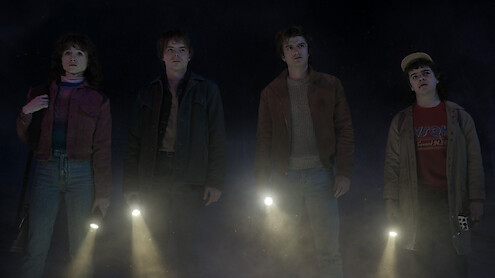
The final season brings the Hawkins group back into the supernatural war Vecna helped unleash. Credit: Netflix.
How Vecna dies
The finale runs three fights at once, and Vecna loses all of them.
Eleven, Kali and Max attack Henry inside his mind in Camazotz, which stops the merger. The rest of the party climbs into the Abyss and finds the Pain Tree — which then unfolds its branches into legs and reveals itself as the Mind Flayer. The ground battle is a deliberate ensemble piece: Nancy baits the creature toward a canyon, Jonathan and Robin attack from above, Lucas launches accelerant, Mike ignites it, and Dustin and Steve go underneath with spears. Matt Duffer has compared the structure to the climax of a Dungeons & Dragons campaign, every character contributing a specific skill.
With the Mind Flayer dead, the fight narrows to Henry. Eleven is close to finishing him when he gains the advantage — and Will overpowers him from inside the connection, giving Eleven the opening to drive his body onto a spire.
The killing blow is Joyce Byers’. She beheads him with an axe. Ross Duffer has said it came down to Joyce because she was the first person in Season 1 to act on the belief that something was wrong in Hawkins. Bower’s account of playing the death is the most human note in the character’s history: choking on blood, what he was trying to convey was a plea for the axe not to fall.
That is what physically happens. Thematically, the death and the cave scene preceding it are the same event. Henry is shown the truth of his own origin — the boy, the scientist, the rock — is visibly shaken by it, and still refuses the exit. He would rather be the author of his life than the victim of it, even when authorship means owning every murder since 1959.
The writers’ room considered it directly and said no.
Ross Duffer has confirmed they discussed giving Henry a turn against the Mind Flayer — a Billy Hargrove moment, or a Darth Vader one — and concluded the character had gone too far for it to be credible. The reasoning is psychological rather than moral: after everything he has done, the only way Henry can live with himself is to insist he chose it. Redemption would require accepting that he was used, and accepting that would make his entire life meaningless to him.
Bower has consistently played him as more sympathetic than the plot allows, and has said the most rewarding part of the role was people telling him they understood the character — not that they endorsed him, but that his pain was legible.
The finale threads both. Henry is given every ingredient of a redemption — the buried memory, the mirror in Will, the offer of help — and declines. That is a stronger ending than a turn would have been, because it makes the refusal the last choice he ever gets to make.
Why Vecna works as Stranger Things’ final villain
Every previous antagonist in this series was a shape without an argument. The Demogorgon was appetite. The Mind Flayer, until Season 5, was weather — an intelligence too large and too alien to negotiate with.
Vecna is the only one who wants something you can disagree with. He has a thesis about human beings, a childhood that explains it, a grievance that is partly legitimate, and the manners to set it out at length before he kills you. He is also the only monster in the show made by the same institution that made its hero: Brenner’s lab produced both of them, from the same blood.
That is what the finale is finally about. Will and Henry were both used as vessels by the same entity, then answered that connection in radically different ways. Will turns toward his friends. Henry, even after being forced to confront the memory he buried, chooses the Mind Flayer’s side.
The horror of Vecna was never that he was strong. It was that his story is only a few decisions away from somebody else’s.
Make Red Reactions a preferred source
Choose Red Reactions as a preferred source in Google Search.
Confirm your choice on Google.
Related coverage
Eleven Explained: Jane Hopper's Full Story, Powers and What the Ending Means
Who Eleven really is, where her powers actually come from, and what Stranger Things 5 decided to do with her at the end — Jane Ives, Jane Hopper, Number Eleven, all of it.
The Upside Down Explained: What Stranger Things 5 Finally Revealed
Stranger Things 5 rewrote our understanding of the Upside Down. Here is how the wormhole, the Abyss, Eleven, Vecna and the frozen 1983 Hawkins copy actually connect.

Stranger Things: Tales From '85 Season 2: Release Date, Story and Where It Fits in the Timeline
Stranger Things: Tales From '85 Season 2 premieres September 17, 2026 on Netflix. Here's what the animated series actually is, where it picks up, who's returning, and when it takes place in the Stranger Things timeline.
The Gentlemen Season 2 Character Guide — Who's Who, Who Betrays Who and Where Everyone Ends Up
From Eddie Horniman and Susie Glass to the new Italian faction, here's every major character in The Gentlemen Season 2, how they connect, and where they stand by the finale.
About the author
Aram Anwar
Founder & Editor
Aram Anwar founded Red Reactions and writes across comics, gaming, movies and television. His work includes franchise guides and large Lore / Explained features, with an emphasis on separating confirmed details from reports, theory and speculation.
Coverage: Comics · DC & Marvel · Gaming · Movies & TV · Lore / Explained · Guides
More from Aram Anwar