lore · tv
The Upside Down Explained: What Stranger Things 5 Finally Revealed
Stranger Things 5 completely changed what we know about the Upside Down. Here is how the wormhole, the Abyss, Eleven, Vecna, the Mind Flayer and the 1983 Hawkins copy actually fit together.

For almost a decade, Stranger Things trained viewers to think they understood the Upside Down.
It looked like Hawkins.
It contained the same roads, houses and buildings.
It was dark, cold, covered in vines and spores, and full of creatures that seemed to belong to another ecosystem entirely.
So the obvious explanation was also the one the characters used: the Upside Down was a dark parallel dimension — a corrupted copy of Hawkins existing beside the real world.
That explanation was never quite complete.
Season 4 made the mystery harder by revealing that the Upside Down’s version of Hawkins was frozen on November 6, 1983, the night Will Byers disappeared and Eleven opened the gate at Hawkins Lab. It also showed Henry Creel being thrown into a completely different-looking dimension years earlier, raising a question that the show deliberately refused to answer at the time.
Then Stranger Things 5 finally pulled the pieces together.
The Upside Down is not the original home of the Demogorgons, the Mind Flayer or Vecna’s other creatures.
It is not simply the alien world Eleven sent Henry into.
And it is not best understood as an ordinary alternate Earth.
The final season reveals that the Upside Down is an interdimensional wormhole — a bridge connecting Hawkins to another realm called the Abyss.
That changes almost everything we thought we knew about the mythology.
So what exactly is the Upside Down? What is the Abyss? Why does the bridge look like Hawkins in 1983? Did Eleven create it? Did Vecna create it? Where did the Mind Flayer actually come from? And what happened to the Upside Down in the series finale?
Here is the complete explanation based on all five seasons.
Major spoiler warning: This article contains full spoilers for Stranger Things 5, including the series finale.
What is the Upside Down?
The final answer is surprisingly specific:
The Upside Down is a wormhole connecting Hawkins, Indiana, to another dimension known as the Abyss.
Dustin reaches that conclusion in Season 5 after studying Dr. Brenner’s research.
For years, the group had treated the Upside Down as the other world itself. They assumed the Demogorgons, vines, Mind Flayer and everything else existed naturally inside the shadow version of Hawkins.
Season 5 reveals that assumption was wrong.
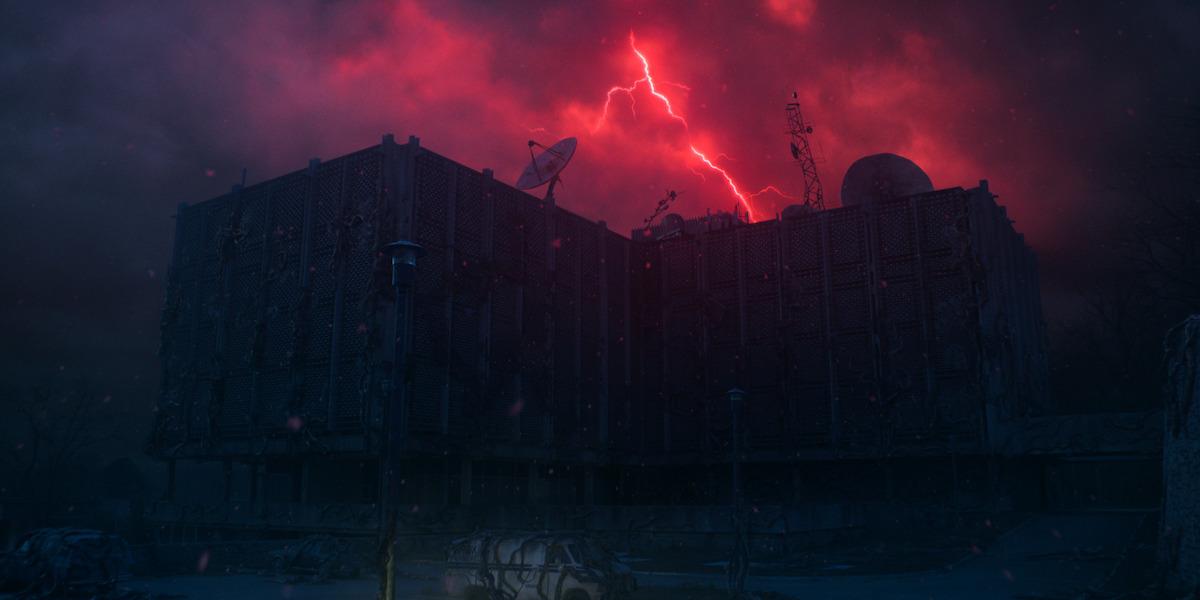
The dark Hawkins environment is essentially the bridge.
On one end is the real Hawkins.
On the other is the Abyss.
That distinction explains why so many earlier pieces of the mythology appeared to contradict one another. The dimension Henry entered in the Season 4 flashbacks did not look like the Upside Down because it wasn’t the Upside Down.
It was the Abyss.
The Upside Down came later.
What is the Abyss?
The Abyss is the actual alternate dimension connected to Earth by the Upside Down.
Dustin names it after the chaotic evil realm from Dungeons & Dragons, continuing the show’s tradition of using D&D terminology to give understandable names to supernatural things the kids encounter.
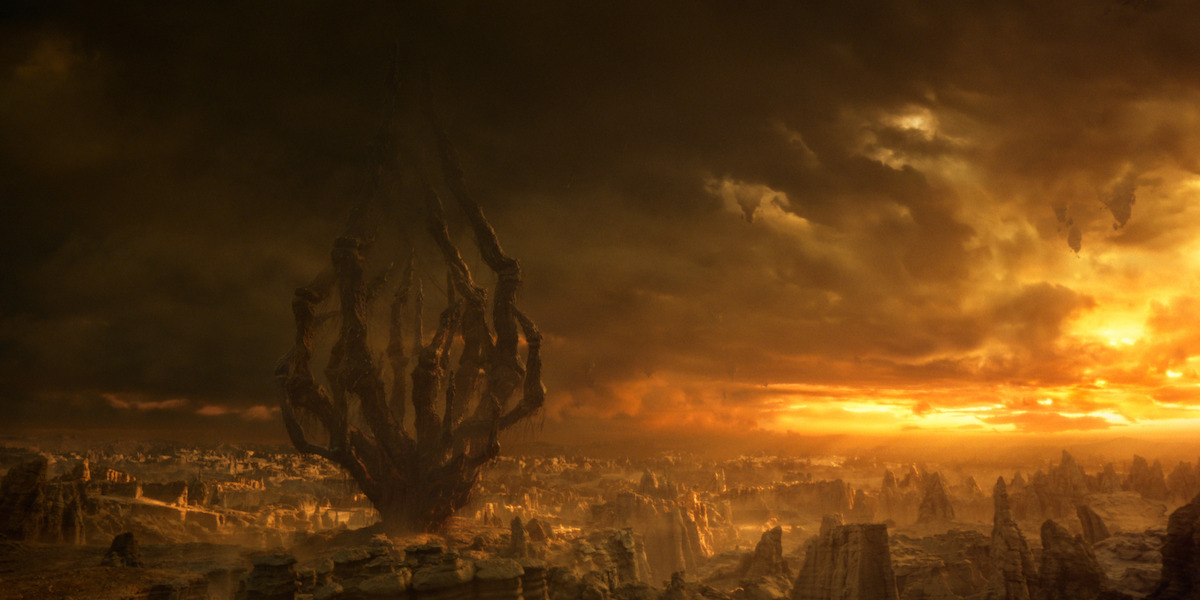
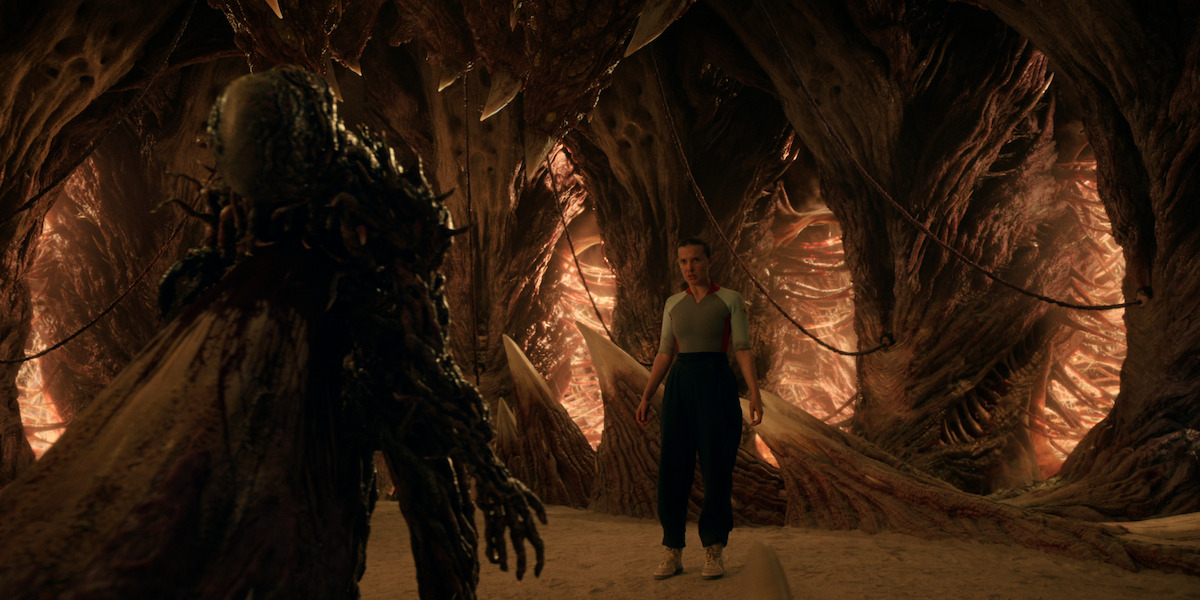
Visually, the Abyss is very different from the Upside Down.
Instead of a decaying copy of Hawkins, it is an alien landscape filled with jagged rock formations, deep canyons and a violent yellow-orange sky. It has its own geography rather than duplicating Indiana.
Most importantly, the Abyss is the home of the creatures that viewers spent years associating with the Upside Down.
That includes the ecosystem connected to:
- Demogorgons,
- the vines,
- the Mind Flayer,
- and the other creatures used by Vecna.
Season 5 therefore creates a clean distinction:
The Abyss is the world.
The Upside Down is the bridge.
That is probably the single most important lore reveal in the final season.

The Abyss is the alien dimension on the far side of the Upside Down. Credit: Netflix.
Where did Eleven send Henry Creel?
One of the biggest misconceptions after Season 4 was that Eleven created the Upside Down when she blasted Henry Creel out of Hawkins Lab in 1979.
That is not what Season 5 establishes.
When Eleven defeats Henry in the Rainbow Room flashback, she sends him into the Abyss.
At that point, there is no Hawkins-shaped Upside Down bridge.
The realm Henry falls through is a violent, unfamiliar alien environment. It contains floating structures and strange atmospheric energy, but it does not resemble Hawkins.
Season 5 explicitly identifies that destination as the Abyss.
Henry survives there and eventually becomes the figure the Hawkins group knows as Vecna.
That means the basic timeline is:
- 1979: Eleven banishes Henry into the Abyss.
- Henry remains in the alien dimension.
- 1983: Eleven later makes remote psychic contact with the Abyss while Brenner is using her powers to search for Henry.
- That contact creates the Upside Down bridge between Hawkins and the Abyss.
- The creatures on the Abyss side can now use that bridge to reach Earth.
The difference between 1979 and 1983 is the key to the entire mythology.
Did Eleven create the Upside Down?
Yes — but with an important qualification.
Eleven did not create the Abyss.
She did not create the alien ecosystem.
She did not create the Mind Flayer.
And she did not create Henry’s destination in 1979.
What Season 5 establishes is that Eleven’s later psychic contact with the Abyss formed the Upside Down wormhole connecting the two realities.
That makes Eleven responsible for the bridge, not for the existence of the world on the other side.
It also makes the first season more tragic in retrospect.
Brenner’s obsession with exploiting Eleven’s psychic abilities does not merely cause a monster to escape.
His experiments create the connection that gives Henry and the Abyss a permanent route back toward Hawkins.
The opening disaster of Stranger Things was never just about an unlocked door.
It was about creating the hallway.
Why does the Upside Down look exactly like Hawkins?
This is where the wormhole reveal helps make sense of one of Season 4’s biggest mysteries.
The Upside Down contains a near-perfect shadow version of Hawkins: houses, streets, schools, the library, Hawkins Lab and other locations all exist where their real-world counterparts should be.
But the copy does not keep updating.
Nancy discovers in Season 4 that her Upside Down bedroom contains objects and diary entries only up to November 6, 1983.
That is the night Will disappeared.
It is also the night Eleven’s contact with the creature on the other side led to the opening of the Hawkins Lab gate.
Season 5 establishes that Eleven’s remote contact with the Abyss formed the Upside Down itself.
The strongest reading, therefore, is that the bridge took on the shape of Hawkins at the moment it formed.
That interpretation neatly explains why the environment appears frozen in 1983.
But there is a useful distinction between what the show directly says and what the mechanism strongly implies.
CONFIRMED: the Upside Down is frozen as a copy of Hawkins on November 6, 1983.
CONFIRMED: the Upside Down formed when Eleven made remote contact with the Abyss.
ANALYSIS: its frozen Hawkins layout appears to preserve the real world as it existed at the moment the bridge came into being.
The final season gives us enough information to make the connection without requiring the show to deliver a lecture explaining every duplicated chair and wallpaper pattern.
Why was Will Byers taken?
Will’s disappearance on November 6, 1983 becomes even more significant once we know the bridge had just formed.
He is not simply unlucky enough to wander near an alternate dimension that had always been sitting beside Hawkins.
He disappears at the beginning of a brand-new supernatural connection between Earth and the Abyss.
The Demogorgon uses that connection to hunt in Hawkins.
Will is dragged through and becomes one of the first human victims trapped inside the bridge environment.
His survival then leaves him with a connection that continues to matter for the rest of the series.
Season 2 turns that connection into possession by the Mind Flayer.
Later seasons show that Will can still sense Vecna and the hive mind.
And the final season brings Will’s story back to the mythology that began with his disappearance.
That symmetry is important.
Stranger Things starts with Will being swallowed by a mystery nobody understands.
It ends after he finally understands what that mystery was and helps destroy the forces behind it.
Is the Upside Down alive?
The answer is more complicated than simply yes or no.
The Upside Down behaves like an organic environment.
Its surfaces are covered in vines.
Spores fill the air.
The tendrils can react to intrusion.
Creatures share information through a hive-mind-like network.
But Season 5 reveals that the bridge itself depends on a physical energy structure: exotic matter.
The giant sphere seen above Hawkins Lab is not something Vecna created through magic. It is an exotic-matter energy source stabilizing the wormhole.
That is a major shift in how the environment works.
The Upside Down may look biological, but it is also held together by a phenomenon the characters interpret through science.
This is very Stranger Things.
The show has always blended supernatural horror with Cold War science fiction. The final explanation does not choose between those traditions.
It gives us an alien organic network wrapped around an interdimensional structure maintained by exotic matter.
What is the giant flesh wall?
Season 5 introduces another striking feature: the enormous wall surrounding the traversable Upside Down environment.
Dustin initially interprets the system by comparing it to the shield around the second Death Star in Return of the Jedi. He suspects the mysterious sphere is effectively powering a defensive barrier controlled by Vecna.
That theory is wrong.
The sphere is not Vecna’s magical shield generator.
It is exotic matter.
The wall is part of the structure containing the unstable wormhole.
And beyond it is not another section of Hawkins waiting to be explored.
There is effectively nothing safe to enter.
When the exotic matter is disturbed, the environment begins collapsing into the void.
That is why damaging the sphere is so dangerous even to people inside the Upside Down.
Destroying the bridge means destroying the space they are standing in.
Did Vecna create the Upside Down?
No.
This was one of the biggest theories after Season 4, and Season 5 makes the answer much clearer.
Henry does not create the Abyss.
He does not create the Mind Flayer.
And he does not independently construct the Hawkins-shaped wormhole.
Eleven’s remote contact with the Abyss is what forms the bridge.
Vecna later uses that connection.
This distinction changes how we should understand him.
He is extraordinarily powerful, but he is not the creator-god of the entire supernatural ecosystem.
He is a human who entered an already existing alien dimension, became entangled with the entity living there and learned to turn the connection to Earth into a weapon.
That is still terrifying.
It is just different from creating the universe himself.
Did Vecna create the Mind Flayer?
Season 4 strongly encouraged viewers to believe he did.
Henry enters the alien realm, discovers a vast cloud of dark particles and eventually shapes those particles into the spider-like form we recognize as the Mind Flayer.
Because Henry has always been obsessed with spiders, the visual implication seemed obvious: he found raw material and transformed it into his perfect monster.
Season 5 complicates that assumption dramatically.
The final season establishes that the Mind Flayer existed as an independent force connected to the Abyss and that its relationship with Henry began much earlier than viewers understood.
The finale reveals a childhood incident involving young Henry, a mysterious scientist and a black rock containing Mind Flayer particles. Those particles possess Henry.
That means Henry’s relationship with the Mind Flayer is not simply “man invents monster.”
The entity was already there.
Was Vecna controlling the Mind Flayer — or was it controlling him?
The show deliberately refuses to give a perfectly clean answer.
By the finale, Henry insists that he chose the path he followed and willingly embraced the Mind Flayer’s view of humanity.
Will argues that Henry was manipulated.
The Duffer Brothers have said they intentionally leave open the question of how much control the Mind Flayer exerted over young Henry from the beginning.
But the ending resolves the part that matters most morally:
Henry ultimately chooses the Mind Flayer’s side.
That makes two simplistic explanations inaccurate:
- “Vecna created and controlled the Mind Flayer the whole time.”
- “Henry was an innocent puppet with no responsibility.”
The truth is more uncomfortable.
The Mind Flayer influenced Henry profoundly.
Henry also chose to embrace what it represented.
By the end, the two are allies in the destruction they want to bring to Earth.
What is the hive mind?
Throughout the series, the supernatural creatures repeatedly behave as parts of a connected system.
Damage one section of the network and something elsewhere can react.
Will can sense the Mind Flayer.
Demodogs collapse when the gate is closed.
Vines, creatures and possessed hosts can behave like extensions of a larger intelligence.
The final mythology clarifies why that connectivity should not be described as “the Upside Down itself thinking.”
The creatures originate in the Abyss and are linked through the Mind Flayer’s network.
The Upside Down is the bridge that allows that network to extend toward Hawkins.
That distinction matters because the environment and the intelligence controlling creatures are not necessarily the same thing.
The road is not the driver.
Why do gates open in different places?
Gates are openings between Earth and the interdimensional bridge.
The original Hawkins Lab gate is created through Eleven’s psychic contact.
Other temporary openings appear through supernatural activity.
Vecna later uses his murders in Season 4 to create four massive gates whose intersection tears Hawkins apart.
Those gates do not each lead to a completely different universe.
They connect into the same bridge system between Hawkins and the Abyss.
By Season 5, the consequences have become large enough that Hawkins is under military quarantine and human forces are operating directly inside the supernatural environment.
What began as a secret crack in a laboratory wall has become infrastructure in a war between worlds.
Why couldn’t the Demogorgons just stay on Earth?
The show repeatedly indicates that the creatures depend on their connection to the wider supernatural network.
Season 2 demonstrates this clearly when closing the gate cuts off creatures associated with the Mind Flayer.
Season 3 raises the same problem with the Russians’ captured creatures and attempts to reopen access.
Season 5 makes the architecture clearer.
The creatures belong to the Abyss.
The Upside Down bridge gives them access to Earth.
Cutting that bridge is therefore not merely closing one door behind one monster.
It is severing the route between ecosystems.
What did the Russians actually discover?
The Soviet storyline becomes slightly easier to understand after the final reveal.
The Russians knew there was an interdimensional phenomenon and attempted to force a gateway open.
They understood enough to recognize its military potential.
They did not possess the complete cosmological picture.
Like the Hawkins group, they were interacting with the bridge without necessarily understanding the Abyss waiting beyond it.
That is an important theme throughout Stranger Things.
Brenner, the Soviets and later the military all believe the supernatural can be studied, contained or weaponized.
Every time, human ambition underestimates the scale of what has been opened.
What is the difference between the Upside Down and Camazotz?
Season 5 introduces additional psychic spaces that can make the mythology confusing if every strange location is treated as another name for the same place.
The Upside Down is the physical interdimensional bridge.
The Abyss is the alien dimension on the far side.
Camazotz is connected to the psychic/memory-based spaces used by Henry and other characters during the final conflict.
It should not automatically be treated as another physical region of the Upside Down.
Stranger Things has always used mental spaces — especially through Eleven and Vecna — that characters can experience without physically walking into another geographic location.
Keeping psychic landscapes separate from physical dimensions prevents the final season’s mythology from becoming more confusing than it needs to be.
What was the Pain Tree?
The Pain Tree initially appears to be a horrifying structure holding Vecna’s kidnapped children inside the Abyss.
The finale reveals something worse:
the Pain Tree is the Mind Flayer.
Its enormous structure unfolds into the creature’s spider-like form during the final battle.
The children are connected through the tree and its vines while Vecna carries out his plan.
This reveal makes the Mind Flayer’s visual identity across the series feel more coherent.
The giant shadow shape, the organic tunnels, the vines and the final monstrous body are all expressions of an entity whose biology and influence can extend through different forms.
The Mind Flayer was never simply a cloud hovering over another dimension.
It was the central organism behind much of the ecosystem Henry learned to exploit.

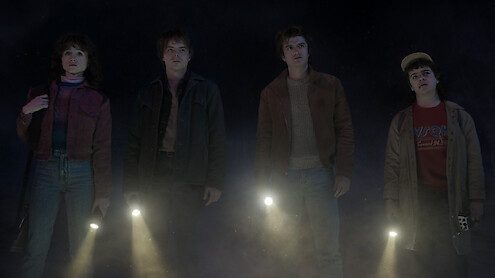
The Hawkins crew spent years treating the Upside Down as another world before learning it was the bridge to one. Credit: Netflix.
Why did Vecna want to merge the Abyss with Earth?
Vecna’s endgame is larger than opening gates and releasing monsters.
He wants to bring the Abyss into Earth.
That would erase the separation between the human world and the alien ecosystem allied with the Mind Flayer.
Season 4 begins that process when his four murders tear Hawkins open.
Season 5 escalates it into an attempted full merger.
The Upside Down is essential because it is the bridge making that merger possible.
Once the characters understand this, their final strategy changes.
They no longer need merely to close individual gates.
They need to destroy the bridge.
How do they destroy the Upside Down?
The exotic matter holding the wormhole together becomes the key.
Earlier damage proves that disturbing it destabilizes the environment, but not enough to destroy the bridge completely.
For the final plan, the group places a bomb inside the Upside Down and targets the structure keeping the wormhole intact.
Hopper and Murray remain behind long enough to set the timer.
After Vecna and the Mind Flayer are defeated and the kidnapped children are rescued, the survivors escape.
The bomb detonates.
The wormhole collapses.
The Upside Down is destroyed.
The Duffer Brothers have compared the concept to The Bridge on the River Kwai: the final strategic objective is not simply defeating enemies on the far side but blowing up the bridge they use to reach you.
That metaphor is almost absurdly literal once Season 5 explains the mythology.
Is the Abyss destroyed too?
This requires slightly more careful wording.
The heroes’ plan is designed to destroy the bridge and eliminate the supernatural threat connected through it. The finale shows Vecna and the Mind Flayer defeated and the Upside Down collapsing, bringing Hawkins’ long interdimensional crisis to an end.
The clearest confirmed visual outcome is the destruction of the Upside Down wormhole.
The show does not spend its closing minutes giving us a scientific survey proving that every square mile of the independent Abyss dimension has ceased to exist.
For that reason, the safest formulation is:
The Upside Down is destroyed, the Mind Flayer and Vecna are killed, and the route connecting Hawkins to the Abyss is eliminated.
That is enough to end the immediate threat without inventing a broader cosmological claim the finale does not need to make.
What happens to Eleven when the Upside Down collapses?
This is deliberately unresolved.
Before the explosion, Eleven appears to remain inside the Upside Down.
Mike sees her as the bridge collapses and believes she has been erased with it.
Later, however, he tells a more hopeful version of events during the group’s final D&D game.
In his story, Kali uses one final illusion to make Eleven appear to remain behind while she actually escapes. Eleven then lives somewhere far away where the government cannot find her.
The Duffer Brothers intentionally leave the truth ambiguous.
The ending is not:
CONFIRMED: Eleven dies.
It is also not:
CONFIRMED: Eleven secretly survives.
The series ends with Mike and his friends choosing to believe the hopeful version.
That distinction matters, especially in an explainer. The uncertainty is part of the ending rather than a puzzle with an official answer hidden off-screen.
So what actually happened on November 6, 1983?
With the full mythology available, the night Stranger Things begins can finally be reconstructed more clearly.
Eleven is being used by Brenner in experiments at Hawkins Lab.
Her psychic abilities make contact with the Abyss.
That contact forms the interdimensional bridge we call the Upside Down.
The bridge takes on the physical layout of Hawkins at that point in time.
A gate opens at the laboratory.
Creatures from the Abyss gain a route toward Earth.
Will Byers disappears.
Everything that follows grows from that moment.
That is why November 6, 1983 is not merely the date when the first season happens to begin.
It is effectively the birth date of the Upside Down.
Again, the exact phrase “birth date” is interpretation, but the underlying chain of events is now canonically supported by the final season.
The Upside Down was never the real monster
The final reveal also changes the meaning of the show’s most famous location.
For years, the Upside Down itself seemed evil.
It was where monsters lived.
It was where Will suffered.
It was where Barb died.
It was where the Mind Flayer’s influence appeared to originate.
But the final season reveals something more interesting.
The Upside Down is not necessarily the source.
It is the connection.
That makes the show’s central horror less about discovering that another world exists and more about what happens when people insist on opening pathways they do not understand.
Brenner wants knowledge and control.
The Soviets want a weapon.
The military wants supernatural power.
Henry wants to tear down the human world.
Each of them sees the boundary between dimensions as something to exploit.
The heroes ultimately win by doing the opposite.
They destroy the connection.
The mythology in one simple diagram
After five seasons, the basic cosmology can be reduced to this:
EARTH / HAWKINS
↓
Gates
↓
THE UPSIDE DOWN — an interdimensional wormhole shaped like Hawkins as it existed on November 6, 1983
↓
THE ABYSS — the alien dimension connected to Earth, home to the Mind Flayer and the supernatural ecosystem Vecna uses
Henry is thrown into the Abyss in 1979.
The Upside Down bridge forms in 1983 after Eleven remotely contacts that realm.
Vecna and the Abyss creatures use the bridge to attack Hawkins.
The bridge is destroyed in the 1987 final battle.
That is the cleanest version of the mythology the series leaves behind.
What Stranger Things 5 finally answered
By the end of the series, several of the franchise’s longest-running questions finally have clear answers.
Is the Upside Down an alternate universe?
Not exactly. It is a wormhole/bridge connecting Hawkins to an alternate dimension.
What is the actual alternate dimension?
The Abyss.
Did Eleven create the Abyss?
No.
Did Eleven create the Upside Down?
Her remote contact with the Abyss formed the bridge.
Did Eleven send Henry to the Upside Down in 1979?
No. She sent him to the Abyss.
Did Vecna create the Mind Flayer?
No. The Mind Flayer existed independently and had influenced Henry long before the events viewers originally associated with his transformation.
Who controlled whom — Vecna or the Mind Flayer?
The show deliberately leaves the full extent of the Mind Flayer’s control over young Henry ambiguous, while making clear that adult Henry ultimately chooses its side.
Why is the Upside Down frozen in 1983?
It preserves Hawkins as it existed on November 6, 1983, the date the bridge formed. The exact copying mechanism is not exhaustively explained.
What keeps the Upside Down stable?
Exotic matter.
Does the Upside Down survive the finale?
No. The wormhole collapses after the group detonates the bomb.
Does Eleven survive?
Intentionally unresolved.
The answer was hidden in the name all along
“The Upside Down” was never a scientific term.
It was a name created by children trying to understand something impossible.
That is one of the smartest things about the final reveal.
Mike, Dustin, Lucas and Eleven saw a dark copy of Hawkins and gave it a name that made sense to them.
For years, audiences accepted their explanation because we knew no more than they did.
Season 5 does not say the kids were foolish.
It says they were looking at only one part of a much larger structure.
The Upside Down was a copy of home.
It was also a road.
And the thing everyone thought was the monster’s world was actually the space connecting them to something even farther away.
That makes the final destruction of the Upside Down more than another explosion.
The first episode opens a connection that steals childhood from almost everyone in Hawkins.
The final episode closes it.
After five seasons of people trying to weaponize, study, control and invade the space between worlds, the characters finally understand enough to do the one thing nobody in power was willing to do:
leave the other side alone.
Related coverage

What Is Quadratum? Kingdom Hearts IV's Strange New World Explained
Quadratum is at the center of Kingdom Hearts IV. Here's what the games actually establish about Sora's strange new world, Strelitzia, Yozora and the Lost Master Arc.

Who Is Mister Sinister? Powers, Origin and X-Men History Explained
From Nathaniel Essex and Apocalypse to Madelyne Pryor, Cable, Krakoa and Sins of Sinister, here's the complicated history and powers of the X-Men villain Mister Sinister.

Sylar Explained: Powers, Abilities and Why He Became Heroes' Greatest Villain
Who is Sylar in Heroes? A complete guide to Gabriel Gray's origin, intuitive aptitude, stolen powers, hunger, redemption arc and why Zachary Quinto's villain became the show's defining threat.

What Happened to Heroes? The Rise, Fall and Legacy of NBC's Superhero Phenomenon
Why did Heroes become a TV phenomenon, and why did it fall so quickly? A look at Season 1, the writers' strike, cancellation and its legacy.
About the author
Bamo A
Independent commentary and editorial analysis from the Red Reactions team.