lore · anime
Beerus Explained — His Power, Ultra Ego Connection and Role in Dragon Ball Super
Beerus is Universe 7's God of Destruction, the being who maintains cosmic balance by destroying rather than creating. Here's how his power, his bond with Whis, and his connection to Vegeta's Ultra Ego actually work.
 By Bamo Anwar6 min read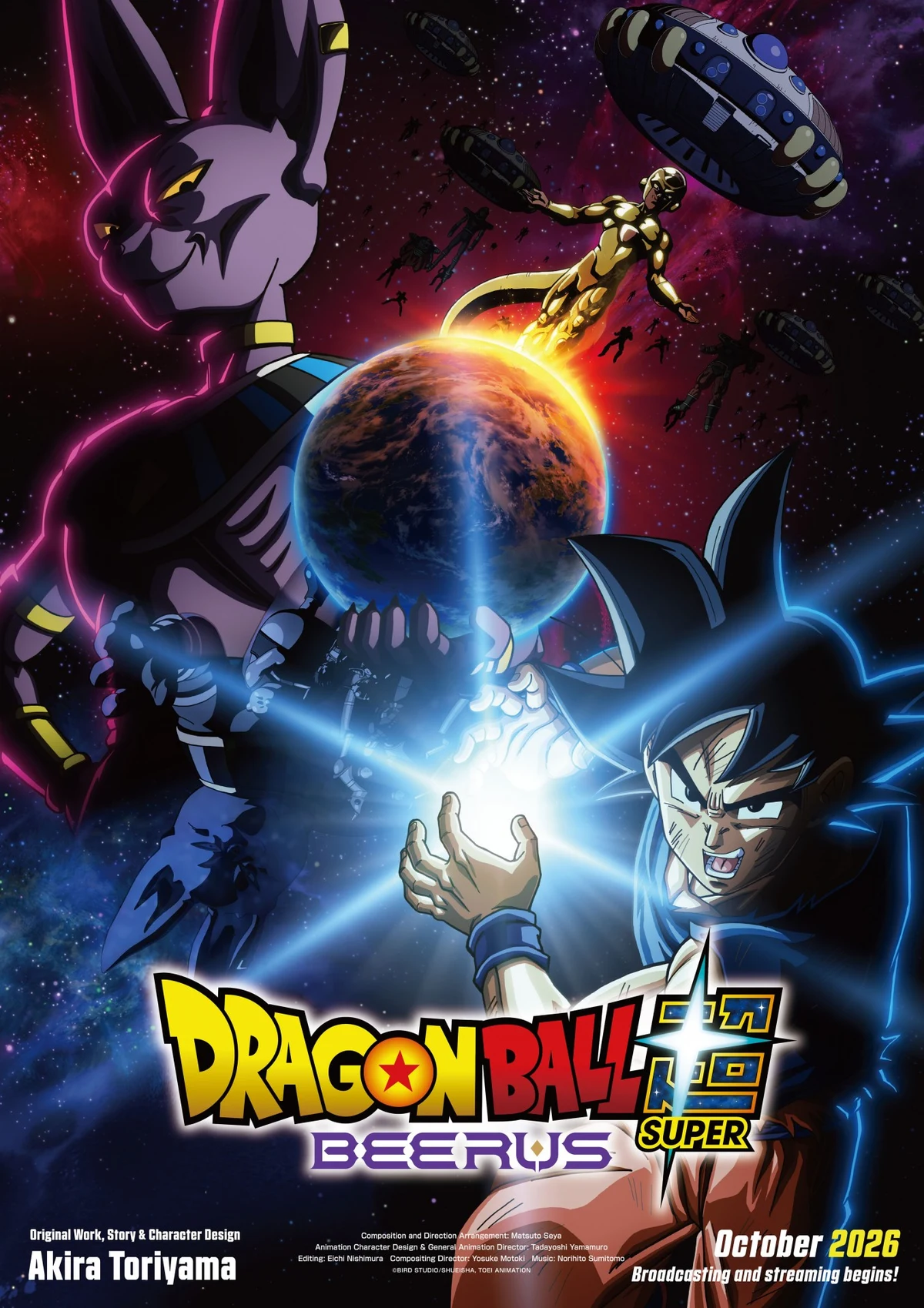
Beerus is the God of Destruction of Universe 7 — the being whose entire cosmic function is to destroy rather than create, balancing out the Supreme Kais on the opposite side of that equation. He’s introduced as Dragon Ball Z: Battle of Gods’ central threat in 2013 and has been reshaping the franchise’s power structure ever since. With Toei’s ENHANCED remake bringing his introduction arc back to screens on October 11, here’s what’s actually established about him — and what isn’t.
Who Is Beerus?
Beerus is one of the Gods of Destruction — one per universe in Dragon Ball’s multiverse structure — whose job is to maintain cosmic balance by destroying planets, civilizations and threats that grow dangerous enough to upset it. He looks like a slender purple cat-like deity in Egyptian-inspired dress, and that appearance undersells how casually dangerous he is: his introduction arc is built entirely around the fact that Beerus deciding to destroy Earth is a real possibility, not a hypothetical.
The Hakai Technique
Beerus’s signature and most dangerous ability is Hakai — Destruction. It’s described in-story as capable of completely obliterating a target down to nothing: not just planets or physical matter, but intangible things as well. Every God of Destruction can use some version of Hakai, but Beerus wields it as his defining technique. This isn’t a power level number the franchise assigns a fixed value to — it’s a category of ability, and treating it as a quantifiable stat rather than what it actually is (near-total erasure of whatever it’s aimed at) overstates how precisely Dragon Ball’s own material defines it.
Beerus and Whis
Whis is Beerus’s attendant and martial arts teacher, and their dynamic is one of the more interesting relationships Dragon Ball Super built its early seasons around. Whis isn’t a servant in any functional sense — he’s explicitly stronger than Beerus, serves as his combat instructor, and frequently talks him down from destructive impulses Beerus would otherwise act on. Beerus himself has named Whis as the strongest opponent he’s ever faced, with Goku ranked second — a specific, stated comparison rather than a fan estimate. That framing matters: even a God of Destruction answers to someone, and Whis’s role as both caretaker and superior is part of what keeps Beerus’s power in check throughout the series.
Beerus and Supreme Kai
Beerus’s relationship with the Supreme Kai of Universe 7 (Shin) is more than professional rivalry between destruction and creation — it’s mechanically linked. Their lives are bound together: if the Supreme Kai dies, so does Beerus, despite the enormous gap in raw power between them. That built-in vulnerability is a real, stated weakness in Beerus’s setup, not a plot convenience invented for one scene — it’s part of why other characters can occasionally threaten a God of Destruction indirectly, by threatening the far weaker Kai his existence is tied to.
How Beerus Compares to Goku and Vegeta
This is the section worth being disciplined about, because Dragon Ball fandom’s power-scaling culture is famous for treating trailer footage and single fight outcomes as fixed rankings. What the story itself actually establishes: Beerus defeated Goku’s Super Saiyan 3 form in their first confrontation while explicitly holding back a significant amount of his own power. That’s a real, stated in-story fact, not a fan estimate — but it describes one encounter at one point in the story, not a permanent, unchanging gap. Goku and Vegeta have both grown substantially since Battle of Gods, through Super Saiyan Blue, Ultra Instinct and Ultra Ego respectively, and Dragon Ball has never published a fixed power number system that lets any of this be stated as precise math. Treat “Beerus was vastly stronger than Goku in 2013” as accurate, and treat any claim about exactly how the gap stands today as speculation the source material doesn’t actually support.
Beerus’s Connection to Vegeta’s Ultra Ego
This is one of the more concrete, manga-confirmed threads tying Beerus directly into another character’s growth. Vegeta first achieves the Ultra Ego transformation in the Dragon Ball Super manga’s Granolah arc (Chapter 74, 2021), and it’s explicitly framed as the result of Vegeta pursuing proper God of Destruction training — following what the story calls “Beerus’ path of destruction,” as a direct counterpart to Goku’s pursuit of Ultra Instinct through Whis and the Angels. Vegeta’s Ultra Ego design itself echoes Beerus: purple hair and aura, and a gold earring styled after Beerus’s own jewelry. Beerus is himself established as a user of the same underlying destruction-based power Ultra Ego draws from, which is why the connection isn’t just aesthetic — Vegeta’s transformation is presented in-story as walking the same path Beerus himself represents, not merely a visual homage.
Manga vs. Anime Differences
Beerus’s story has been told across multiple, not always identical versions. Battle of Gods (2013) and Resurrection ‘F’ (2015) were films first, later adapted into anime episodes with some differences in pacing and scene detail. Toei’s own 2026 ENHANCED edition, branded Dragon Ball Super: Beerus, explicitly reworks that material again — official materials describe “extensive new cuts, revisions to existing scenes, a complete re-rendering of all footage” aimed at a more faithful adaptation of Akira Toriyama’s original ideas. That’s worth knowing if you’re comparing versions: the “definitive” screen take on Beerus’s introduction has changed more than once, and the newest version is explicitly framed as a correction toward the source material rather than a simple remaster. Our full breakdown of what the ENHANCED edition actually changes covers the specifics.
What’s Currently Confirmed for 2026
Beyond the ENHANCED edition’s October 11 Japan premiere, Toei has also confirmed Dragon Ball Super: The Galactic Patrol — a separate, newly produced anime adapting the manga’s Galactic Patrol Prisoner arc — as in production, though without a confirmed release date as of this writing. Neither project has published new plot details specific to Beerus beyond what’s already part of his established story. Treat anything more specific than that as unconfirmed.
The Short Version
Beerus is Universe 7’s God of Destruction, bound by his role to maintain cosmic balance, answerable to Whis as both teacher and superior, and tied to the Supreme Kai’s life in a way that undercuts his own overwhelming power. His Hakai technique is total erasure rather than a quantifiable stat, and his influence extends into Vegeta’s Ultra Ego as a manga-confirmed continuation of his own destruction-based philosophy. What he isn’t is a fixed number on a power-scaling chart — Dragon Ball’s own material has never worked that way, and neither should how you think about him.
Sources
Related coverage
Dragon Ball Super: Beerus Gets October 11 Premiere Date — What the "Enhanced" Edition Actually Changes
Dragon Ball Super: Beerus premieres in Japan on October 11 at 11:15 p.m. JST. Here's what the official ENHANCED edition actually rebuilds, what the new Super Surge trailer shows, and why it's not The Galactic Patrol.

Street Fighter 6 x Star Detective Precure Is a Four-Episode Battle Hub Mystery Starting December 17
Capcom and Toei Animation are crossing over Street Fighter 6's Battle Hub with the currently-airing Star Detective Precure! anime for a four-episode original mystery story starting December 17, 2026.

Star Detective Precure! Movie Trailer Brings Three Precure Teams Together Before September 18 Release
Star Detective Precure! The Movie: The Mysterious Garden and the Secret of the Two gets two new trailers ahead of its September 18, 2026 Japanese release, bringing in characters from You and Idol Precure and Wonderful Precure. Here's what's confirmed.

Mononoke Beginner Guide — Watch Order and Where to Stream the 2007 Anime
Toei Animation's Mononoke is a 12-episode anthology anime now streaming on Netflix. Here's what it actually is, how it connects to Ayakashi and the 2024 movie, and the right way to start watching.
About the author
Bamo Anwar
Anime & Gaming Writer
Bamo Anwar covers anime and gaming for Red Reactions. His work ranges from release news and detailed trailer breakdowns to beginner guides, watch orders and explainers designed to make large franchises and game systems easier to enter.
Coverage: Anime · Gaming · Beginner Guides · Watch Orders · Explainers
More from Bamo Anwar