Movies Review
Spoiler-lightFacing El Chapo Review: Netflix's Crime Thriller Finds Its Tension in Two Ordinary Cops
Facing El Chapo (La captura) puts two federal police officers, not El Chapo, at the center of its story. The choice mostly pays off, even when the film around it slows down.
 By Kenza Benouna7 min read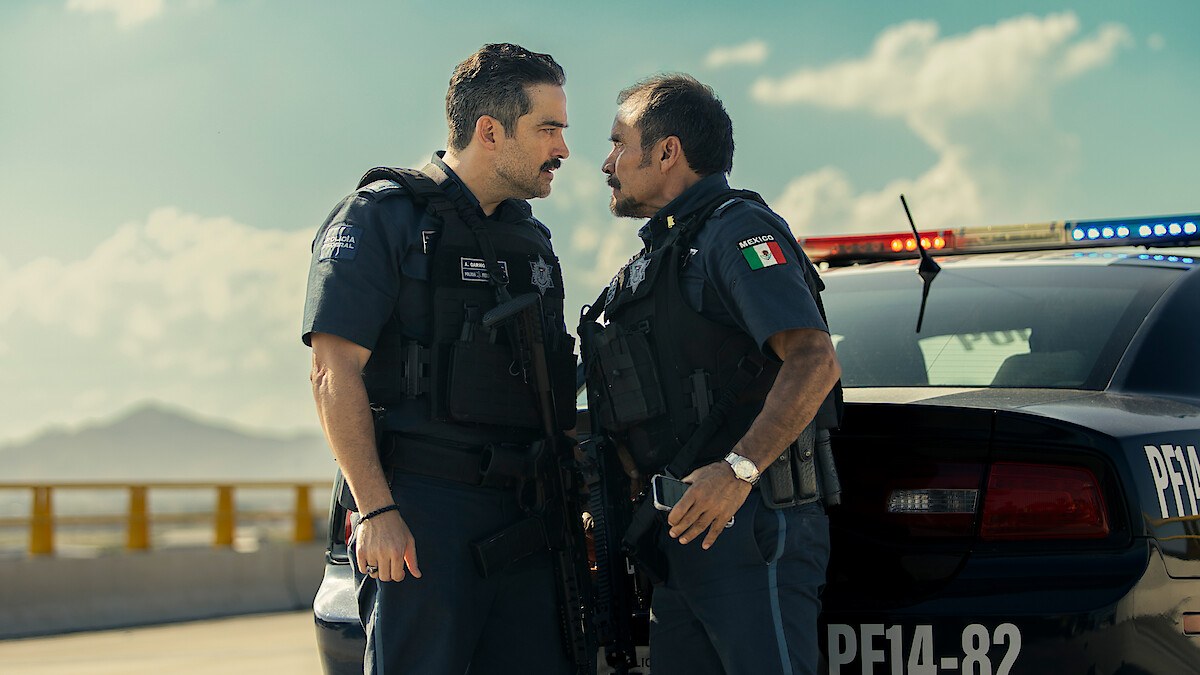
Facing El Chapo — released internationally under that title and in Spanish as La captura — makes one decision early on that shapes everything about whether it works: it isn’t really about Joaquín “El Chapo” Guzmán. It’s about two federal police officers who pull over the wrong stolen car on the wrong night. That choice is the film’s biggest strength, and for most of its 91 minutes it’s enough to carry a tense, well-acted thriller. It isn’t quite enough to make the whole thing land as cleanly as its premise deserves.
Spoiler-light. This review discusses the setup, the two lead performances and the shape of the film’s tension. It does not detail how the central standoff resolves or how the film’s fictionalized ending plays out. The broad historical fact of El Chapo’s 2016 capture is public record, not a spoiler — what happens to these specific characters is where I’ve stayed vague.
A true story told from the wrong side of the badge
Netflix’s own account of the real events is a useful baseline, and it’s worth being precise about where the film departs from it. In January 2016, Guzmán was located in Los Mochis after escaping from Altiplano prison the previous year, fled through the city’s drainage system during a raid, and was ultimately apprehended following a roadside stop by federal police who had no idea who they’d pulled over until it was too late to simply walk away. Netflix has been direct that the officers’ real identities were never made public — which means “Arturo Carmona” and “Héctor Rosales,” the names given to Alfonso Herrera and Noé Hernández’s characters here, are the film’s invention, not a matter of public record. Director Chava Cartas built the script (credited to Bernardo Esquinca, drawing on real-event chronicles the journalist Héctor de Mauleón published around the case) as a dramatization of that gap: two men who found themselves face to face with the most wanted man in the world and had to decide, in real time, what to do about it.
That’s a smarter angle than it might sound. A film that made Guzmán the protagonist would have to either glamorize him or work overtime not to. By centering two comparatively ordinary cops instead, Facing El Chapo sidesteps that problem almost by design — the question isn’t “what is El Chapo capable of,” it’s “what would these two men actually do,” and that’s a more interesting question to build ninety minutes around.
Herrera and Hernández, not Herrera and a sidekick
Alfonso Herrera plays Carmona as a younger officer whose composure is clearly effortful — you can watch him deciding, moment to moment, not to let his face show how far out of his depth he is. It’s a performance built on small physical choices rather than big ones, and it works because the film gives him room to actually think on screen instead of just react.
Noé Hernández, as the older Rosales, is doing the more interesting job of the two, and the film is smart enough to know it. Rosales isn’t there to be the grizzled mentor who explains things to the audience through his partner; he’s carrying his own weight of institutional exhaustion and self-preservation instinct, and Hernández plays the character’s calculations — when to push, when to look away, when trusting Carmona is actually the safer move — as their own throughline, not a supporting act to Herrera’s. The partnership only works as tension because neither man is fully certain of the other, and the film resists the easy version where their loyalty is never in question. That uncertainty, more than any specific plot beat, is what makes the middle stretch of the film work.
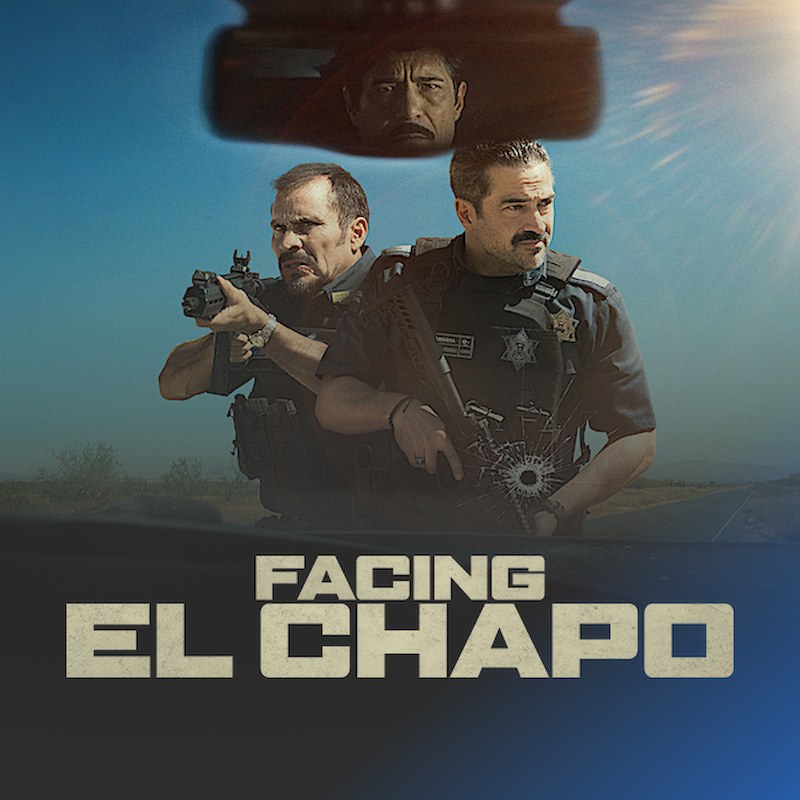
Official key art for Facing El Chapo. Credit: Netflix.
Suspense with a known ending
The trickiest job a based-on-true-events thriller has is generating tension when the audience already knows how the broad story ends — El Chapo was captured, and if you’re pressing play on this movie in 2026, you likely already know that. Facing El Chapo gets around this reasonably well by keeping its uncertainty local rather than historical. You know Guzmán doesn’t escape justice forever; you don’t know what happens to Carmona and Rosales in the space of this one night, and the film is careful to keep their fates — not his — as the actual stakes.
The traffic-stop-turned-standoff material is where that pays off most directly. There’s a real geography to the highway and roadside spaces Cartas shoots in, and the film gets good, specific mileage out of confinement — the inside of a car, the open exposure of a shoulder lane at night, the sense that backup is both too far away and too dangerous to actually call. The tension isn’t built on jump-scare timing; it’s built on the two officers’ slowly dawning understanding of exactly how much danger they’re standing next to, and on a script that understands institutional distrust — not knowing which calls are safe to make, which colleagues can be trusted — as its own source of dread, separate from Guzmán himself.
Where it slows down
The film’s biggest issue is pacing, and specifically the amount of time it takes to actually get its two leads to the moment the whole premise is built around. The setup — establishing Carmona and Rosales as characters, laying groundwork for the world they’re operating in — runs longer than it needs to, and a chunk of that time leans on dialogue-heavy scenes that tell you things the roadside sequences later show far more effectively. It’s not that the character work is bad; it’s that the film seems to distrust its own premise slightly, spending time building sympathy for two men whose situation would generate tension on its own once the story actually gets moving.
The result is a thriller that’s genuinely gripping once it’s gripping, but takes longer than it should to ignite. If you’re watching for the premise described in the marketing, be ready for a first act that’s more procedural table-setting than the tense two-hander the back half delivers.
Héctor Kotsifakis as El Chapo
Kotsifakis has the harder job in some ways, because the film needs him threatening without letting him dominate a story that isn’t supposed to be his. He mostly succeeds. His Guzmán operates through calm, transactional menace rather than volume — the bribery attempts and implicit threats land because they’re delivered like business propositions, not villain monologues, and that restraint keeps the character from tipping into the kind of cartel-boss mythologizing the film is clearly trying to avoid. He’s effective specifically because the script and the performance both refuse to let his reputation alone do the scary work; the tension comes from what he’s actually saying to these two men, not from who he’s rumored to be.
He’s also, by design, thinner as a character than either Carmona or Rosales — which is the correct choice for a film about the officers, but does mean Kotsifakis is working within fairly narrow bounds. He makes the most of them.
The verdict
Facing El Chapo succeeds at the thing it sets out to do: tell this story through the two men who found themselves in the middle of it, rather than turning Guzmán into another antihero crime-thriller lead. Herrera and Hernández’s partnership carries real tension because the film lets their trust in each other stay genuinely uncertain, the roadside and standoff sequences are staged with a real sense of geography and dread, and Kotsifakis avoids the trap of playing El Chapo as pure spectacle. What holds it back from being a great thriller instead of a good one is pacing — a first act that spends too long setting up what its premise was always going to sell on its own — and a villain who, by design, never gets to be more than the threat the story needs him to be. It’s a strong, tense true-crime thriller that finds its best material in two ordinary men making an extraordinary decision, even if it takes its time getting there.
Verdict: 7.5/10
Sources
Make Red Reactions a preferred source
Choose Red Reactions as a preferred source in Google Search.
Confirm your choice on Google.
Related coverage
UNABOMBER Review: Strong Performances, a Simplified Theory, and a 7/10 Result
Strong performances and an effective dual timeline are held back by a simplified psychological thesis.

Narnia: The Magician's Nephew First Trailer Opens the Door to Other Worlds
Netflix's first Narnia trailer introduces magical rings and other worlds. Watch the official video and check February cinema dates, including the UK's earlier opening.

David Kaczynski and Linda Patrik: How the Unabomber's Family Helped Identify Him
Linda Patrik raised the suspicion and David Kaczynski supplied his brother's writings. Their own accounts explain the family decision behind the Unabomber breakthrough.
How Was the Unabomber Caught? The Manifesto, David Kaczynski and the FBI Breakthrough
Publication of the manifesto, a family tip and corroborating FBI investigation led to Ted Kaczynski's arrest. Here is how those steps fitted together.
About the author
Kenza Benouna
Movies, TV & Horror Writer
Kenza Benouna writes about movies and television, with a substantial archive in horror. Her Red Reactions work includes reviews, supernatural and franchise lore, story explainers and analysis of character, atmosphere and adaptation.
Coverage: Horror · Movies · TV · Reviews · Lore & Features
More from Kenza Benouna