lore · gaming
What Is Quadratum? Kingdom Hearts IV's Strange New World Explained
Quadratum is at the center of Kingdom Hearts IV. Here's what the games actually establish about Sora's strange new world, Strelitzia, Yozora and the Lost Master Arc.
 By Kenza Benouna15 min read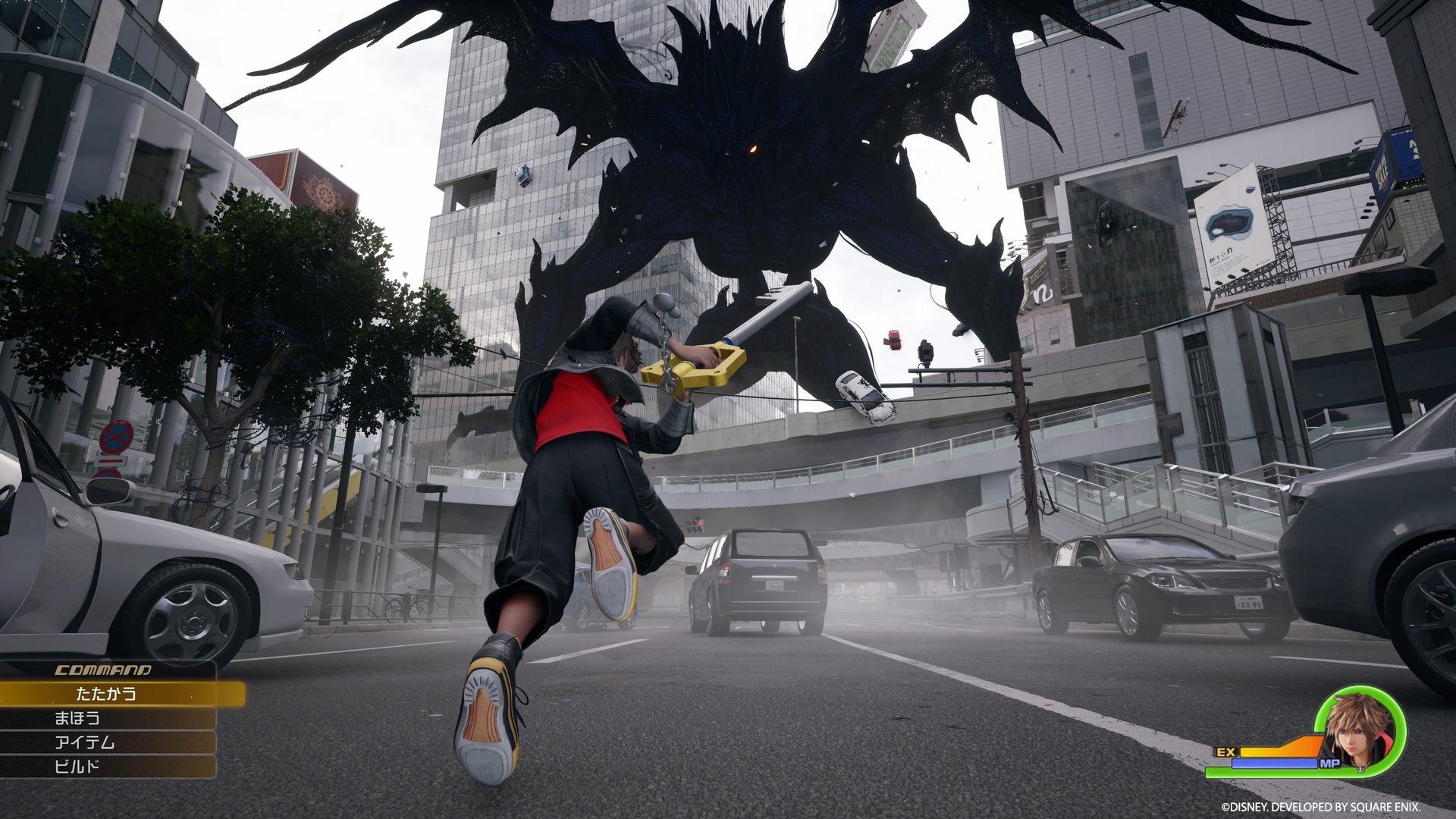
For a series built around impossible Disney worlds, talking animals, sentient weapons and a mythology where hearts can survive without bodies, Kingdom Hearts has found a surprisingly effective way to make its next setting feel alien:
It made it look almost normal.
Quadratum is the realistic modern city at the center of Kingdom Hearts IV. It looks like Tokyo, specifically the kind of dense urban environment associated with Shibuya, but the story treats it as something far stranger than another ordinary world on Sora’s map.
Sora does not simply visit Quadratum. He wakes there after disappearing from the reality he has known for the entire series. Square Enix’s current official description says he is trying to find a way back to his own world while Donald and Goofy search elsewhere for clues to his whereabouts. That makes Quadratum more than a new hub. It is the central mystery that bridges the ending of the Dark Seeker Saga and the beginning of the Lost Master Arc.
The difficulty is that Kingdom Hearts has deliberately given us pieces of the answer rather than one clean definition. Characters have described the reality connected to Quadratum in language associated with fiction, unreality and even an afterlife, but those descriptions are not necessarily interchangeable.
So what is Quadratum actually supposed to be? Why is Sora there? How do Strelitzia and Yozora fit into it? And is it really the “real world” of Kingdom Hearts?
Here is what the games and Square Enix have established so far — and where the theories begin.
Spoiler warning: This article discusses the endings and major late-game material from Kingdom Hearts III, Re Mind, Kingdom Hearts Melody of Memory and Kingdom Hearts Union χ. It does not treat unreleased Kingdom Hearts IV story material as confirmed beyond official trailers, listings and announcements.
What is Quadratum?
At the most basic level, Quadratum is a modern metropolis in a reality separate from the worlds Sora previously traveled through.
Square Enix describes it as a “realistic world” and has repeatedly centered Kingdom Hearts IV around Sora’s time there. The current official game description says Sora awakens in the unfamiliar world of Quadratum and begins searching for a way to return from the modern metropolis to his own world.
That wording matters. It establishes two things without requiring any theory:
- Quadratum is not being treated as just another Disney world.
- Sora is separated from the reality he considers home.
The city is heavily inspired by Tokyo. Its most recognizable imagery evokes Shibuya, including the dense streets, elevated structures and giant urban intersections seen in the trailers. Reuters described Quadratum in its August 2026 coverage as a fictional version of Shibuya.
But visual inspiration should not be confused with literal geography. Quadratum is not simply “Tokyo exists in Kingdom Hearts now.” It is a fictional location built to resemble a contemporary city while serving a much stranger role in the franchise’s cosmology.
Why does Quadratum look so different from the rest of Kingdom Hearts?
The realistic look is intentional.
For most of the series, Sora’s appearance shifts to match the visual language of the world he enters. In The Nightmare Before Christmas, he takes on a Halloween-style form. In Pirates of the Caribbean, the characters move toward more realistic rendering. Disney and Pixar worlds can radically change his proportions, textures and clothing.
Quadratum takes that idea further.
When Sora appears there, his face, hair, clothing and proportions are rendered in a noticeably more realistic style than the familiar Kingdom Hearts III presentation. The city around him follows the same approach.
That does not mean Square Enix has confirmed Quadratum as our literal real world. It means the game’s art direction is communicating that Sora has crossed into a reality with different rules and a different visual identity.
The contrast is part of the story.
A cartoon duck walking into Quadratum would look far stranger than Donald does in Olympus or Twilight Town. Sora, meanwhile, visually adapts to the place almost as if the world itself is translating him.
How did Sora end up in Quadratum?
Quadratum only makes sense if we go back to the end of Kingdom Hearts III.
After the final conflict with Xehanort, Kairi is lost. Sora refuses to accept that ending and uses the power of waking to restore her despite repeated warnings about abusing that power.
He succeeds.
Kairi returns.
Sora disappears.
That is one of the most important consequences in the entire series. The victory at the end of the Dark Seeker Saga does not simply reset everything. Sora pays a price for forcing reality to give Kairi back.
The game’s secret material then begins showing imagery far removed from the familiar worlds of light. Sora is seen in a realistic city. Riku appears in a similarly unfamiliar urban environment. A mysterious figure watches from above.
At the time, the game does not hand the player a clean explanation.
Later material makes the destination increasingly important: Quadratum.
Sora’s disappearance is therefore not best understood as a normal trip between worlds. He has crossed a boundary the series had spent years hinting existed.
Melody of Memory made the mystery much bigger
Kingdom Hearts Melody of Memory is often treated as a rhythm-game side story, but its ending contains some of the franchise’s most important setup for Kingdom Hearts IV.
Kairi’s search for Sora eventually points toward the idea that he may be somewhere beyond the reality the characters understand. The language used around that discovery frames the destination as something outside the normal structure of their universe — a place associated with the “other side” and a reality that can be described as fictional from their perspective.
Riku becomes essential because the city is not completely unknown to him.
He has seen it.
The Nameless Star in the Final World provides another connection, and the story ultimately points Riku toward Quadratum as the place where Sora may be found.
This is where one of the most fascinating Kingdom Hearts ideas emerges:
What if a world can be fictional from one reality and real from another?
The series has played with books, data worlds, dreams and artificial spaces before. Quadratum pushes that concept into something larger. It is not presented merely as a simulation Sora can exit by finding a computer terminal. It appears to exist on the opposite side of a much more fundamental divide.
Is Quadratum “Unreality”?
This is where terminology becomes dangerous.
Fans often use Quadratum, Unreality, fictional world and afterlife as if they all mean exactly the same thing.
The games have not established that.
The safest reading is:
- Quadratum is the city/place where Sora has ended up.
- The reality containing or associated with it exists outside the normal reality familiar to Sora and his friends.
- Characters from Sora’s side have used the language of fiction or unreality when trying to understand that other side.
- That does not prove Quadratum is literally nonexistent, imaginary or fake.
In fact, the entire point may be the opposite.
To Sora, Quadratum is strange.
To someone who belongs there, Sora’s reality may be the impossible one.
That relativity would fit Kingdom Hearts perfectly. Disney worlds already coexist despite having completely different histories and physical rules. Quadratum may take that concept and apply it to entire realities instead of individual worlds.
So calling Quadratum “fake” is misleading.
It is clearly real enough for Sora to wake up, live in an apartment, walk through its streets and fight Heartless there.
Why does Strelitzia call it an afterworld?
The 2022 Kingdom Hearts IV reveal made the mystery even more complicated by putting Strelitzia in Sora’s apartment.
Her presence is significant because Strelitzia comes from the ancient era explored in Kingdom Hearts Union χ, and her story is tied to death and disappearance long before Sora’s time.
In the reveal material, she explains Quadratum to Sora using language that can be understood as an afterworld from their perspective.
That immediately created the popular theory that Quadratum is simply the Kingdom Hearts afterlife.
It is a reasonable theory.
It is not yet a confirmed rule.
The problem is that Kingdom Hearts already has places associated with death and lost hearts, most importantly the Final World. Characters can reach strange states between life and death without automatically being residents of Quadratum.
Sora also did not simply die in an ordinary way. His disappearance followed his misuse of the power of waking and his attempt to rewrite what had happened to Kairi.
Strelitzia’s own situation is unusual as well.
The fact that two characters connected to loss or death are in Quadratum strongly suggests the city is related to boundaries that should normally be difficult or impossible to cross. But until Kingdom Hearts IV explains the system, “Quadratum is the afterlife” goes further than the evidence allows.
A safer interpretation is:
Quadratum can function like an afterworld for people coming from Sora’s reality without necessarily being the universal destination of every dead character.
That leaves room for the language used in the trailers without collapsing every supernatural realm in the franchise into the same place.
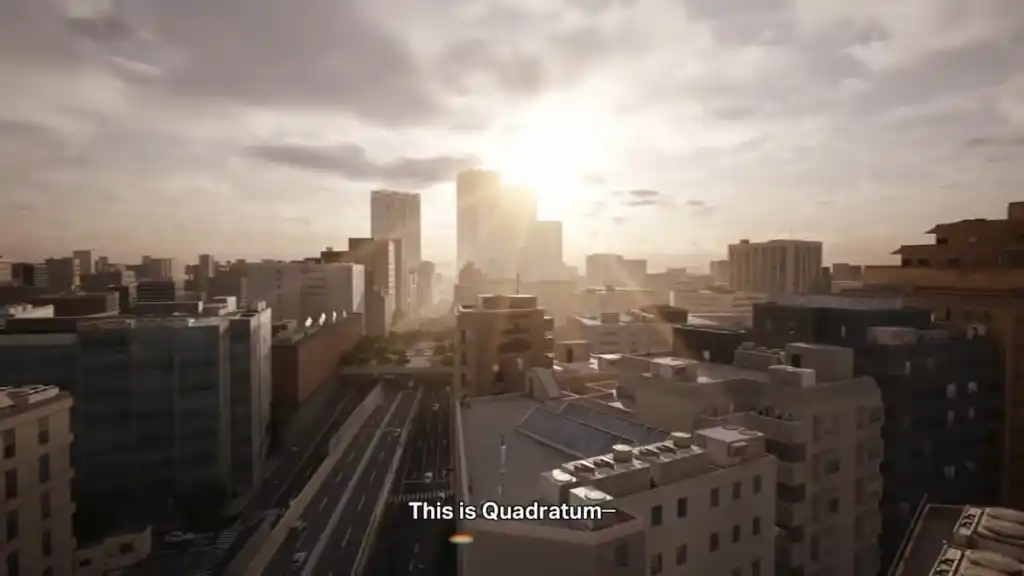
Quadratum deliberately resembles a modern Tokyo-like metropolis. Credit: Square Enix / Disney.
Who is Strelitzia and why is she important?
Strelitzia is not just a random new roommate created for Kingdom Hearts IV.
She originated in the mobile-era storyline that became fundamental to the franchise’s ancient history.
Without turning this into a complete Union χ explainer, the key point is that Strelitzia was selected to become one of the new Union leaders following the Keyblade War era. Before she could take that role, she was attacked and lost her life.
Her appearance in Quadratum therefore creates an obvious question:
How is she here?
The new game has not yet supplied the complete answer.
That mystery is probably more important than simply explaining how Sora got an apartment.
If Quadratum can contain people who were removed from Sora’s normal reality in radically different ways and across completely different eras, then the city could be a meeting point for storylines that were previously separated by centuries.
That is one reason the Lost Master Arc can pull so heavily from the ancient Kingdom Hearts mythology without feeling disconnected from Sora’s immediate situation.
Where does Yozora fit into Quadratum?
If Strelitzia makes Quadratum strange, Yozora makes it almost impossible to read literally.
Yozora first appears within Kingdom Hearts III through Verum Rex, an in-universe video game seen in the Toy Box world.
At first, that seems like a joke and a piece of fictional media inside another fictional universe.
Then Yozora becomes real.
The Re Mind secret episode brings Sora face to face with him. Yozora clearly has his own goals, recognizes that something is wrong with Sora’s identity or appearance, and says he has been told to save him.
The encounter deliberately blurs the line between a fictional character and an independent person.
That is exactly why Quadratum matters.
If Yozora can be fictional from one side of reality while existing as a real person on the other, then Quadratum may be the franchise’s mechanism for turning “fiction” into a matter of perspective rather than an objective category.
It also makes the name Verum Rex — often translated as “True King” — feel less like background flavor and more like a statement about which reality gets to call itself real.
Still, one distinction needs to remain clear:
Square Enix has not confirmed that Quadratum is literally the Verum Rex game world in every detail.
Yozora, the realistic city imagery and the shared visual language are intentionally connected. The exact relationship remains part of the mystery.
Is Quadratum the same Shibuya as The World Ends with You?
No confirmed material establishes Quadratum as the Shibuya from The World Ends with You.
This theory was almost inevitable because Tetsuya Nomura worked on both franchises, and Dream Drop Distance already brought The World Ends with You characters into Kingdom Hearts.
Quadratum also uses imagery strongly associated with Shibuya.
But visual resemblance and shared creators are not enough to merge the settings.
The safest position is that Quadratum is its own Kingdom Hearts location inspired by real Tokyo, not a confirmed crossover with The World Ends with You.
Unless Square Enix explicitly changes that status, articles should not present the two Shibuyas as canonically identical.
Is Quadratum connected to Final Fantasy Versus XIII?
This is the other massive theory — and one with very obvious reasons behind it.
Yozora’s design, Verum Rex, the realistic city, certain shot compositions and the overall tone have reminded fans for years of Final Fantasy Versus XIII, the cancelled/reworked project originally directed by Tetsuya Nomura before its eventual evolution into Final Fantasy XV under a different development path.
The parallels are real as visual and creative observations.
That does not make Quadratum a secret continuation of Versus XIII.
There is a major difference between saying:
ANALYSIS: Kingdom Hearts is deliberately playing with imagery and ideas that recall Nomura’s earlier work.
and saying:
CONFIRMED: Quadratum is the Versus XIII universe.
The second claim has not been established.
Yozora and Quadratum may allow Nomura to revisit themes, aesthetics or concepts that interest him, but Kingdom Hearts IV still has to define those ideas on its own terms.
Treating every visual echo as literal canon would make the lore less accurate, not more.
Is Quadratum the main hub of Kingdom Hearts IV?
All current signs point to Quadratum being one of the most important locations in the game, but Sora is not expected to spend the entire adventure trapped on the same streets.
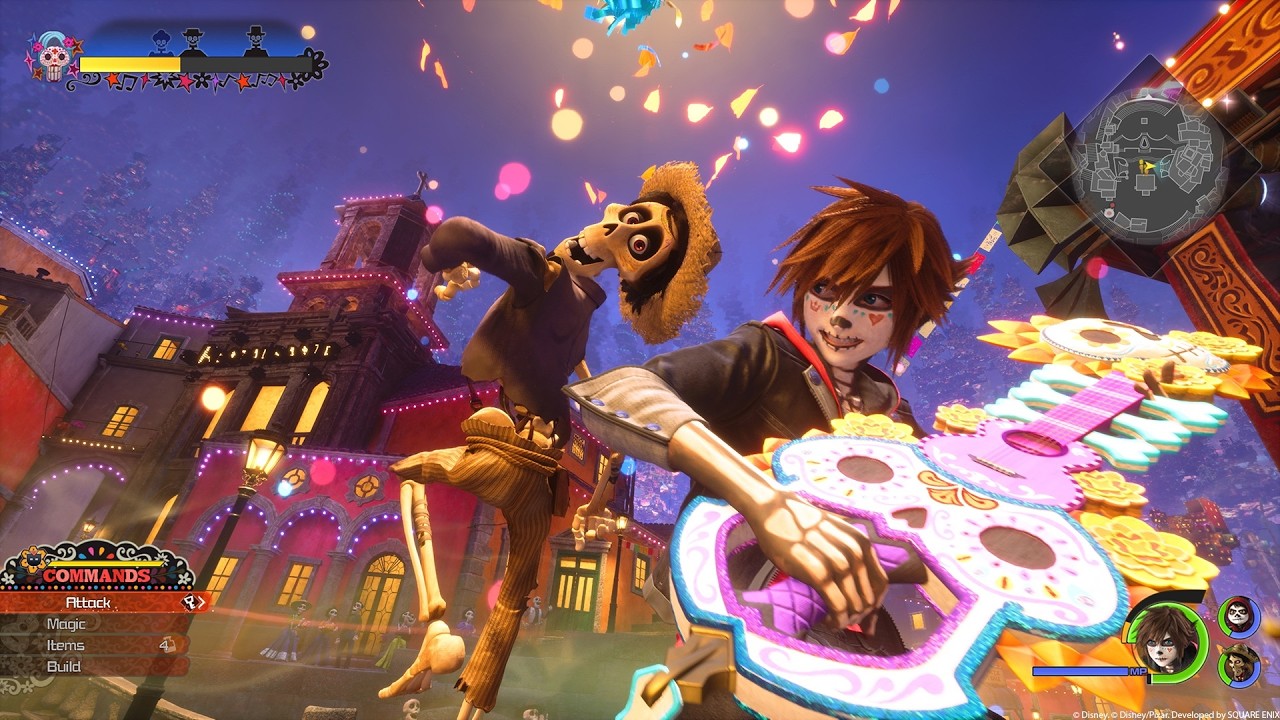
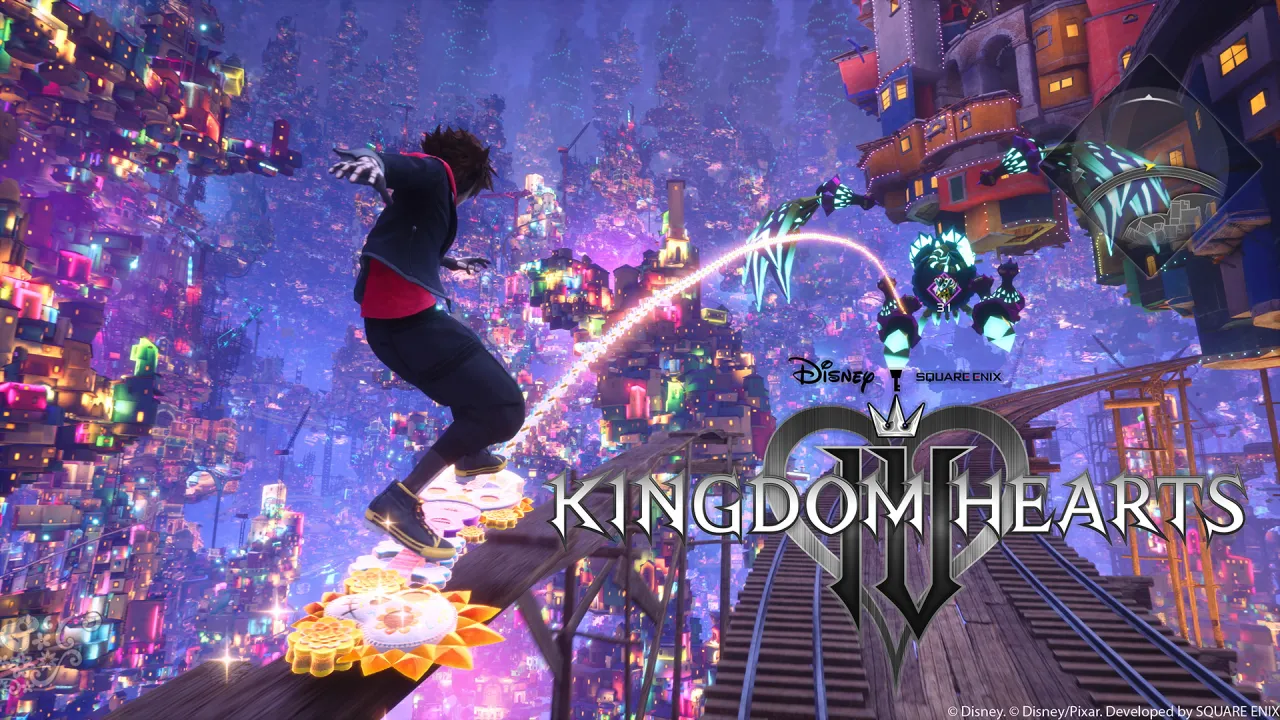
Square Enix and Nintendo’s 2026 material says Sora will journey to other realms and encounter new figures. The D23 showcase then confirmed a world inspired by Pixar’s Coco.
You can read our breakdown of that reveal here: Kingdom Hearts 4 Reveals Coco World, Playable Mickey and Late 2027 Release Window.
That means Quadratum appears to function as the narrative center of Sora’s new journey rather than a replacement for the Disney-world structure.
The official game description also creates a split storyline:
- Sora is in Quadratum trying to return home.
- Donald and Goofy head to the Underworld looking for a clue to his whereabouts.
That is a smart setup because it lets the game explore both sides of the divide at the same time.
Sora can learn what Quadratum is.
His friends can learn what happened to him from the reality he left behind.
Eventually, those two investigations have to collide.
Why can Heartless exist in Quadratum?
This may be one of the biggest questions hidden in plain sight.
The Kingdom Hearts IV footage shows Sora fighting Heartless in Quadratum.
If Quadratum exists beyond the normal reality of the earlier games, why are creatures born from darkness able to appear there?
We do not yet have a complete answer.
But their presence immediately tells us that the boundary between realities is not absolute.
Either the forces familiar to Sora can cross into Quadratum, something has changed because of Sora’s arrival, or the concepts of hearts and darkness extend further than the characters previously understood.
The 2026 footage and official descriptions should be treated as evidence that Heartless are present in Quadratum — not proof of exactly why.
That distinction will matter once Kingdom Hearts IV begins explaining its new cosmology.
Why Quadratum may be the perfect beginning for the Lost Master Arc
The Xehanort story spent years expanding outward.
A simple journey to find Sora’s friends became a war over Kingdom Hearts, ancient Keyblade history, time travel, replicas, sleeping worlds, data realities and versions of characters separated from their bodies and hearts.
By the end, the series had reached a point where simply introducing another villain in another Disney world would feel small.
Quadratum changes the scale again.
Instead of asking what lies beyond one world, it asks what lies beyond reality itself.
That is exactly the kind of setting needed for the Lost Master Arc.
The Master of Masters and the Foretellers are already connected to some of the oldest mysteries in the franchise. Yozora challenges the difference between fiction and reality. Strelitzia connects ancient history to Sora’s present. Riku is searching from the other side. Donald and Goofy are investigating death for clues.
Quadratum gives all of those threads somewhere to meet.
What we know for certain about Quadratum
With a mythology this complicated, it helps to strip away the theories.
As of August 17, 2026, these are the safest confirmed points:
- Quadratum is a major setting in Kingdom Hearts IV.
- Sora wakes there after the events that follow Kingdom Hearts III.
- Square Enix describes it as an unfamiliar modern metropolis separate from Sora’s own world.
- The city is designed with strong Tokyo/Shibuya inspiration.
- Strelitzia is present there.
- The setting is tied to the reality beyond the worlds Sora previously understood.
- Sora is looking for a way home.
- Donald and Goofy are separately searching for clues to Sora’s location.
- Heartless can appear in Quadratum.
- Kingdom Hearts IV begins the Lost Master Arc.
- The game will still send Sora to other realms, including a confirmed Coco-inspired world.
- Kingdom Hearts IV is currently targeting late 2027.
What is not yet confirmed:
- that Quadratum is simply Heaven, Hell or the universal afterlife;
- that everyone who dies goes there;
- that Quadratum is literally our real world;
- that it is the exact Shibuya from The World Ends with You;
- that it is canonically the universe of Final Fantasy Versus XIII;
- that Verum Rex and Quadratum are identical in every respect;
- or that we already understand why Heartless can cross into it.
Those unanswered questions are not gaps to fill with confident guesses.
They are the point.
Quadratum turns Kingdom Hearts’ oldest idea inside out
The original Kingdom Hearts begins with a boy leaving a tiny island and discovering that his world is only one of many.
Quadratum repeats that idea on a much larger scale.
Sora spent years believing reality consisted of connected worlds divided by barriers. He learned to travel between them, protect their hearts and understand the forces that threatened them.
Then he crossed a boundary he did not know how to return from.
Now he is the outsider.
To the people of Quadratum, perhaps his home is the impossible place.
That may be the most interesting direction Kingdom Hearts IV can take. Quadratum does not need to be secretly Tokyo, secretly Versus XIII or secretly a giant afterlife waiting room to matter.
It only needs to force Sora — and the audience — to reconsider what “real” has ever meant in Kingdom Hearts.
And for a franchise where a video-game character can step out of fiction and tell Sora he was sent to save him, that question feels like exactly where the next saga should begin.
Make Red Reactions a preferred source
Choose Red Reactions as a preferred source in Google Search.
Confirm your choice on Google.
Related coverage
Kingdom Hearts IV: Everything We Know About the Story, Worlds, Characters and Release
Kingdom Hearts IV is targeting late 2027 on Switch 2, PS5, Xbox Series X|S and PC. Here's every confirmed detail about Sora's journey through Quadratum, the Coco world, the returning cast and what's still unknown.
Kingdom Hearts 4 Reveals Coco World, Playable Mickey and Late 2027 Release Window
Kingdom Hearts IV is targeting late 2027, with a new D23 trailer revealing a Coco-inspired world, returning Disney characters and playable Mickey gameplay.
Final Fantasy Resonance Demo Guide — What Carries Over and What to Do Before Release
The Final Fantasy Resonance demo covers the Prologue through Chapter 1 and its save data carries over to the October 22 full game. Here's a practical checklist for what to do before launch.
Final Fantasy Resonance TGS Final Trailer — The Crystal Conflict and What the Reveal Adds
Square Enix's Tokyo Game Show 2026 trailer for Final Fantasy Resonance confirms Rain's fight against the Sworn Six, the WurtS theme song, and the October 22 release. Here's what's actually confirmed.
About the author
Kenza Benouna
Movies, TV & Horror Writer
Kenza Benouna writes about movies and television, with a substantial archive in horror. Her Red Reactions work includes reviews, supernatural and franchise lore, story explainers and analysis of character, atmosphere and adaptation.
Coverage: Horror · Movies · TV · Reviews · Lore & Features
More from Kenza Benouna