lore · comics / tv
Vision Quest Comics Explained: What the 1989 Story Means for Marvel's VisionQuest
Marvel's 1989 Vision Quest dismantled Vision, rebuilt him white and fractured his family. Here's what happened — and what Disney+'s VisionQuest is actually borrowing.
 By Aram Anwar12 min read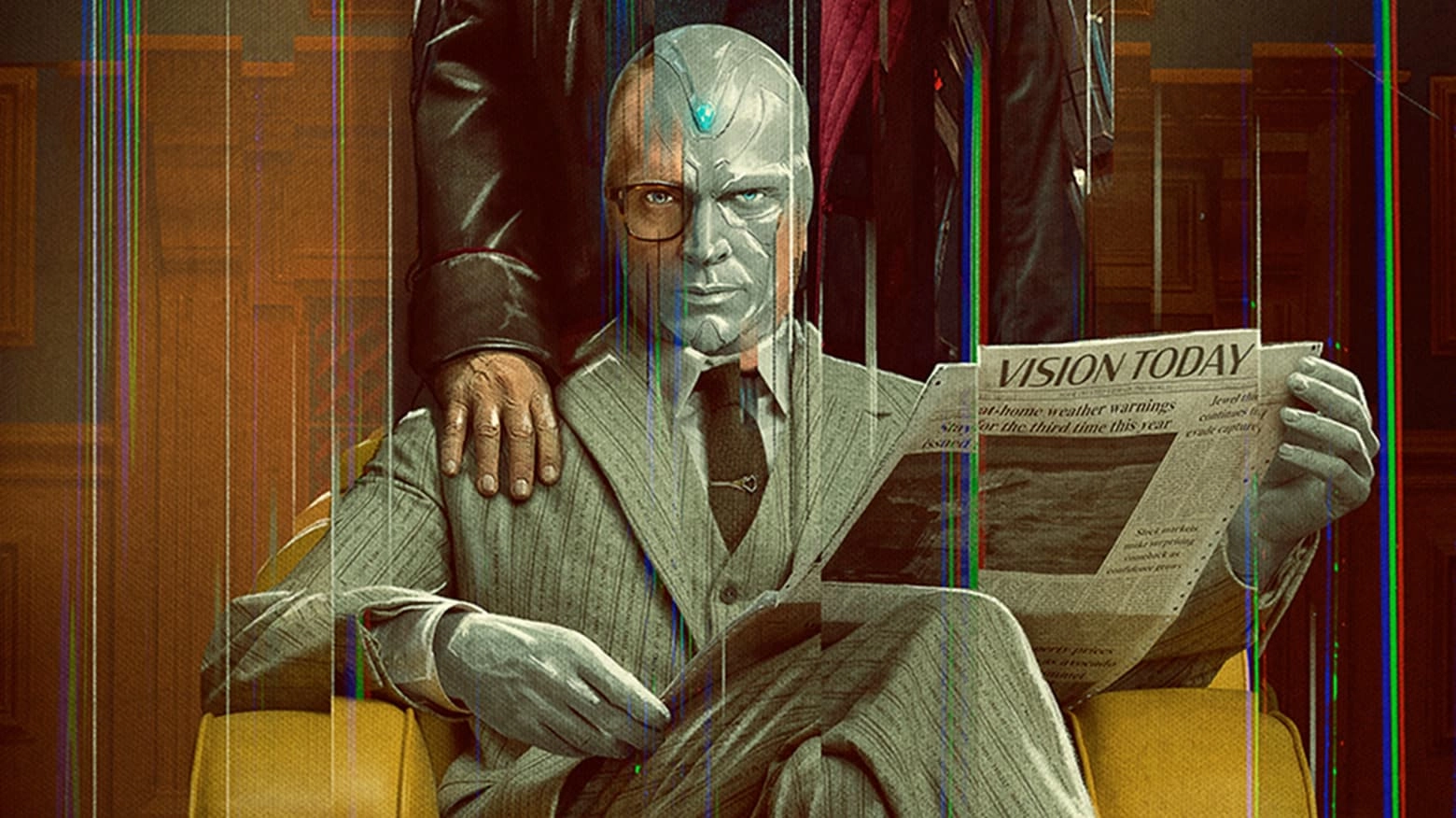
Marvel Television’s VisionQuest takes its name from one of the most consequential Vision stories Marvel has published. But calling the Disney+ series a direct adaptation would be misleading.
John Byrne’s 1989 “Vision Quest” story begins with Vision being abducted, dismantled and reprogrammed before Hank Pym rebuilds him as the all-white Vision. The damage does not stop with his body: the reconstruction severs the emotional identity that tied him to Wanda Maximoff and their family.
The MCU has already used a strikingly similar idea in WandaVision. S.W.O.R.D. dismantled Vision’s corpse, rebuilt the original body as White Vision and sent him back as a weapon. The new VisionQuest series starts after that transformation, with Vision trying to make sense of memories he possesses but struggles to feel.
So the comic matters — just not because Marvel has promised to reproduce its plot.
Spoiler warning: This article discusses major events from West Coast Avengers, WandaVision and Agatha All Along, plus the official premise for VisionQuest.
For the MCU side first, see our complete VisionQuest guide and White Vision explainer.
How many issues is the original Vision Quest story?
There are two answers, and both can be correct depending on what someone means by “Vision Quest.”
Marvel’s own 2021 retrospective identifies the core transformation arc as West Coast Avengers #42–45. Those are the issues in which Vision disappears, is found dismantled and returns in his white form.
But Marvel’s current official Vision Quest reading list runs from #42 through #52. That longer version includes the fallout for Wanda, Vision and their children.
That distinction matters because online summaries often squeeze everything — Vision’s reconstruction, the collapse of his marriage and the truth about Billy and Tommy — into four issues. The actual story unfolds in stages.
If you only want the famous White Vision transformation, read #42–45.
If you want the family consequences that made the storyline so important, continue through #52.
Why was Vision kidnapped?
Byrne did not have Vision dismantled simply because somebody wanted his technology.
Before “Vision Quest,” Vision had taken control of the world’s computer systems and accessed America’s nuclear codes. Even after that crisis ended, the idea that an Avenger could reach that deeply into global infrastructure made governments see him as a security threat.
Marvel’s official White Vision history identifies Project Vigilance, led by Cameron Brock, as the operation behind his capture.
In West Coast Avengers #42, Vision disappears.
By #43, the Avengers find him at a Vigilance facility in pieces.
Mockingbird also has an ugly connection to what happened. Marvel’s own recap says she helped orchestrate the kidnapping before realizing how far Vigilance intended to go and changing her mind too late.
The goal was not to hold Vision.
It was to make sure the version of Vision capable of becoming that powerful could not come back unchanged.
What Project Vigilance did to Vision
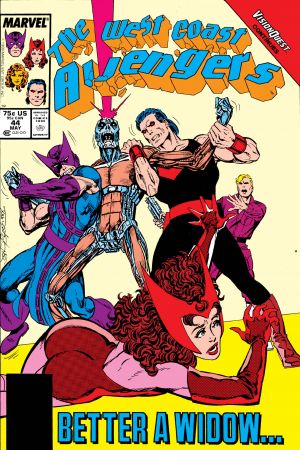
West Coast Avengers #44. Cover art by John Byrne. Credit: Marvel Comics.
Vision is not merely switched off. Vigilance takes him apart and reverse-engineers him.
That image — Vision reduced to components on a table — became one of the defining visuals in his comics history.
The Avengers recover what is left, and Hank Pym attempts the reconstruction. Physically rebuilding Vision is possible. Recreating the person Wanda knew is much harder.
Vigilance had compromised Avengers computer systems, wiping material Pym would have needed to reproduce the accumulated data and mental patterns that made up Vision’s identity. Marvel’s retrospective describes Pym’s initial result as a recreated body without the old emotional imprint or memories.
That creates the real problem at the heart of “Vision Quest”:
How much of Vision can you replace before the rebuilt synthezoid is no longer the same person?
The MCU would ask almost exactly the same question more than 30 years later.
Why does Vision become white in the comics?
The all-white Vision debuts from the reconstruction, with his synthetic skin left chalk-white rather than his familiar red, green and yellow appearance.
The submitted version of this article claimed that Vigilance specifically destroyed his “pigmentation circuits.” That is more technical certainty than Marvel’s own material supports, so it is better not to build the explanation around it.
What matters in Byrne’s story is what the new appearance communicates.
This is Vision’s original form reconstructed into something visibly unfamiliar. The body may be recognizable, but the person Wanda expects to find inside it is not there in the same way.
Modern Marvel material routinely calls this incarnation White Vision, although within the story he remains Vision.
Why Wonder Man matters
To understand why Hank Pym cannot simply reinstall Vision’s personality, you need Simon Williams.
Wonder Man’s brain patterns were used as a foundation for Vision’s human-like personality and emotional responses.
Pym asks Simon to provide those patterns again.
Simon refuses.
Part of his objection is personal autonomy: the original use of his brain patterns was not something he had freely chosen. But there is another complication that makes the decision much messier — Simon is in love with Wanda.
Marvel’s official recap is explicit about that unrequited love.
Without another transfer, the reconstructed Vision does not regain the emotional imprint Wanda expects. Data about a relationship and the experience of loving someone are not treated as the same thing.
That distinction is much more important than the color of Vision’s body.
Does White Vision remember Wanda in the comics?
This part is often summarized too neatly.
At the moment Hank Pym rebuilds him, Marvel describes the reconstructed Vision as lacking the accumulated memories and emotional imprint that made up the old personality. Pym subsequently restores data, but restoring information does not recreate the emotional connection Wonder Man’s brain-pattern matrix once supplied.
Marvel’s own Scarlet Witch and Vision reading guide describes the result this way: after Vision is reprogrammed and initially returns without memories of Wanda, Pym restores his data, but Wanda still cannot reconnect with the person he has become.
So “Vision remembers everything but feels nothing” is useful shorthand for where the character ends up, but it skips the reconstruction process.
The more accurate point is:
Information can be restored. The old emotional identity cannot simply be copied back into place.
That is the comic idea VisionQuest is most obviously positioned to revisit.
Vision Quest does not end Wanda and Vision’s marriage overnight
Another common shortcut is that “Vision Quest ended their marriage.”
It starts the breakup. It does not resolve the whole relationship in four issues.
Wanda gets Vision’s body back, but the rebuilt Vision has no meaningful emotional connection to being her husband or the father of their children. Marvel describes “Vision Quest” as the first unraveling of their marriage, with the damage continuing through later Avengers West Coast stories.
That is crueler than a simple death-and-resurrection plot.
Vision is standing in front of Wanda. He can be repaired, can process information and can continue functioning as an Avenger.
He just is not the husband she had before Vigilance took him apart.
Billy and Tommy are part of the longer Vision Quest fallout
The twins are also where separating #42–45 from the extended #42–52 reading order becomes important.
Billy and Tommy were born to Wanda and Vision years before Byrne’s run. During the later Vision Quest issues, the family comes apart further as the boys’ supernatural origin is exposed.
Marvel’s official Wiccan and Speed history explains that Wanda had unknowingly used fragments tied to Mephisto when creating her sons. The twins are lost, and Agatha Harkness suppresses Wanda’s memories of them.
Those events happen after the core White Vision reconstruction, particularly across the later issues Marvel includes in its current Vision Quest reading list.
Years later, Marvel reintroduces the twins as Billy Kaplan and Tommy Shepherd, Wiccan and Speed. Young Avengers establishes their connection, while Avengers: The Children’s Crusade eventually has Wanda embrace them as the reincarnations of her lost sons.
That comics history matters to the 2026 series because Thomas Shepherd is now part of its official premise.
It does not mean Marvel Television is adapting those comics scene for scene.
The MCU already used the biggest Vision Quest parallel
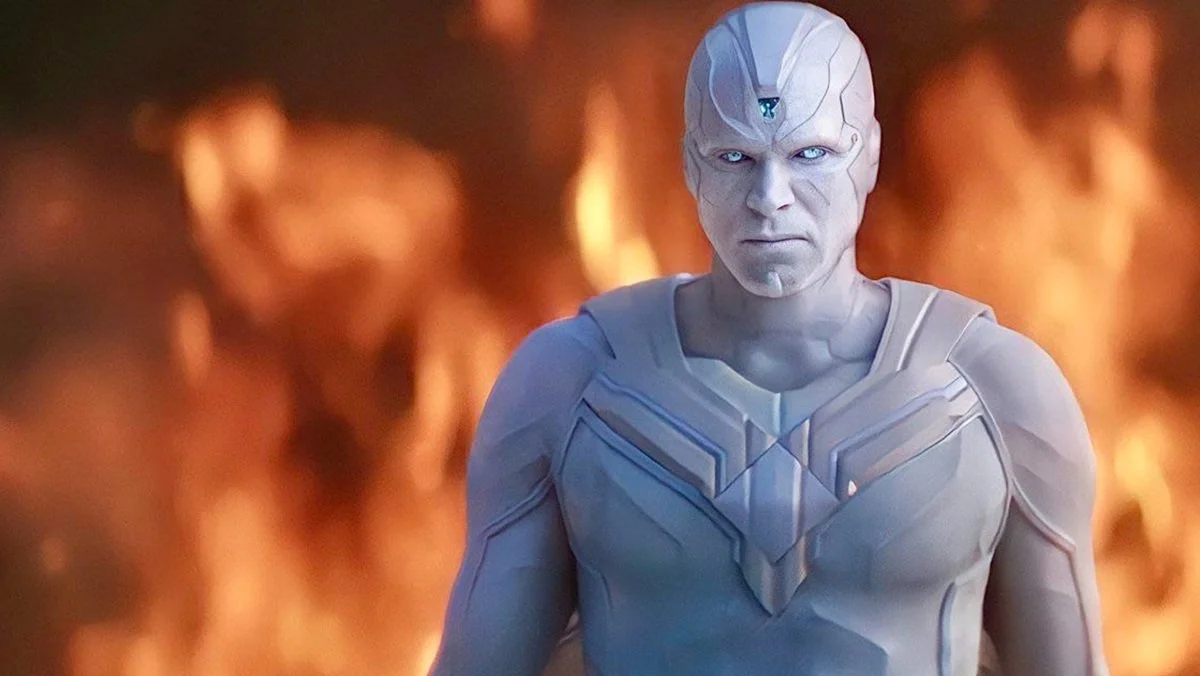
White Vision in the MCU. Credit: Marvel Studios / Disney+.
By the time Marvel Television’s VisionQuest begins, the MCU has already burned through much of Byrne’s most recognizable setup.
In Avengers: Infinity War, Thanos kills Vision by tearing the Mind Stone from his forehead.
S.W.O.R.D. later recovers the original synthezoid body. WandaVision shows technicians dismantling it and attempting to reactivate it under Tyler Hayward’s Project Cataract.
They eventually succeed, producing the colorless White Vision and deploying him as a weapon.
The mechanics are different from the comic, but the resemblance is hard to miss:
| 1989 comics | MCU |
|---|---|
| Vision is seized by Project Vigilance | S.W.O.R.D. takes possession of Vision’s dead body |
| He is dismantled and reprogrammed | His body is repeatedly dismantled and reconstructed |
| Hank Pym rebuilds him | S.W.O.R.D. rebuilds and reactivates him |
| He returns in an all-white form | He returns as White Vision |
| His old emotional identity is missing | His memories are locked and his emotional connection is fractured |
| Wonder Man’s brain patterns are central | There is no confirmed MCU equivalent to the Wonder Man mechanism |
The WandaVision finale then adds its own version of the identity question.
Hex Vision unlocks the archived memories inside White Vision. White Vision leaves Westview with access to the record of his old life, but that does not automatically restore the person who lived it.
Our White Vision explainer goes through that MCU history in full.
What Marvel’s VisionQuest is actually about
Marvel Television’s VisionQuest premieres October 14, 2026, on Disney+, with Paul Bettany returning as Vision and Terry Matalas serving as showrunner. Marvel also confirms James Spader’s return as Ultron. The series is the final installment in the trilogy Marvel now groups with WandaVision and Agatha All Along. (Marvel)
Disney’s post-D23 synopsis is unusually specific.
Vision has escaped the people who wanted to weaponize him and is living in hiding. While searching for a new purpose, he consults AI personas embedded in his programming, including J.A.R.V.I.S., F.R.I.D.A.Y., E.D.I.T.H. and Ultron.
Then somebody puts a bounty on him.
Vision is forced on the run with Thomas Shepherd, whom Disney describes cautiously as a mysterious boy who may be Vision’s son reincarnate. Vision must also resist Ultron’s influence while figuring out who Thomas really is. (Disney)
That is a very different plot from Project Vigilance abducting Vision in 1989.
The connection is thematic: identity, memory, artificial life, family and the question of whether rebuilding a person restores the person.
Is VisionQuest directly adapting the Vision Quest comic?
Marvel has not said that it is.
The title is real. The parallels are real. The White Vision design comes directly out of comics history.
But neither Marvel nor Disney has announced the series as a page-for-page — or even formally loose — adaptation of Byrne’s 1989 storyline.
In fact, much of the comic’s central physical plot already happened in WandaVision.
So the safest way to describe the relationship is:
The 1989 Vision Quest is essential background for why White Vision looks and functions the way he does, while the Disney+ series tells a new MCU story built after that transformation.
That also means other comics should be treated carefully.
Tom King and Gabriel Hernández Walta’s The Vision is an obvious thematic companion because it examines Vision, identity and synthetic family life. But Marvel has not confirmed that the 2015 series is direct source material for VisionQuest.
Likewise, Young Avengers is highly relevant to Thomas Shepherd’s comics history. Thomas appearing in the show does not prove Marvel is adapting the Young Avengers plot.
Similarity is not confirmation.
Why Ultron is different from the comic story
The original Byrne arc is not an Ultron comeback story.
The 2026 series is.
Disney’s official premise says Ultron exists among the AI personas embedded in Vision’s programming and that Vision must resist his influence. James Spader is officially back in the role for the first time since Avengers: Age of Ultron.
That makes Ultron part of the new show’s identity problem rather than evidence that Marvel is recreating a specific Byrne plot beat.
Vision’s MCU mind has always been an accumulation of systems and influences rather than one clean origin. Bringing Ultron back inside that question is new territory for the screen version.
For more on that connection, read how Ultron returns in VisionQuest.
Why Thomas Shepherd matters
Thomas Shepherd is the clearest place where the new series reaches beyond the 1989 core arc.
In Marvel Comics, Tommy Shepherd becomes Speed, one of the reincarnated twin sons connected to Wanda and Vision.
In the MCU, Agatha All Along leaves Billy Maximoff searching for his missing brother. VisionQuest now puts Ruaridh Mollica’s Thomas Shepherd beside Vision, but Disney is deliberately not giving away the answer in its synopsis.
The official wording is “may be Vision’s son, reincarnate.”
Until the series resolves that question, it should remain a question.
That is also why saying Young Avengers “supplies the Tommy storyline” goes too far. The comics provide the character’s history; the show has not promised to follow the same route.
What should you read before VisionQuest?
If your goal is to understand the title rather than read decades of Avengers comics, the list is short.
Start with West Coast Avengers #42–45. That is the core Vision transformation Marvel itself identifies as the original “Vision Quest.”
Continue through #52 if you want the full family fallout. Marvel’s current reading list uses #42–52, covering more of Wanda, Vision and the twins.
Read Young Avengers if Thomas Shepherd is your main interest. That is where Tommy and Billy’s later identities become central.
Treat Tom King’s The Vision as a thematic recommendation, not confirmed homework. It is excellent context for Vision’s questions about personhood and family, but Marvel has not announced it as the show’s adaptation blueprint.
The important difference between 1989 and 2026
The comic begins with people deciding Vision is too dangerous to remain himself.
The Disney+ series begins after other people have already made that decision for the MCU version.
That is why the title fits even if the plot is different.
Byrne’s story asks what happens when Vision’s body survives but the identity inside it is taken apart.
VisionQuest starts with White Vision carrying an archive of a life he cannot simply resume — and with Ultron and a possible reincarnated son forcing him to decide what that life means now.
The 1989 comic is not a script for the series.
It is the problem the series inherits.
Make Red Reactions a preferred source
Choose Red Reactions as a preferred source in Google Search.
Confirm your choice on Google.
Related coverage

Who Is White Vision? Vision's Complete MCU Story Before VisionQuest
He isn't a clone, a copy, or a replacement. He's the original Vision's body, rebuilt by people who wanted a weapon. Here's the full story before VisionQuest.

Jocasta Explained: Her Ultron Origin, Powers and VisionQuest Connection
Ultron built her to be his bride, using the Wasp's own brain patterns. She helped destroy him instead. Here's who Jocasta actually is, and what Marvel has confirmed about T'Nia Miller's VisionQuest version.

VisionQuest Watch Order — What to Watch Before Marvel's Vision Series
You don't need forty hours of homework before VisionQuest. Here's the actual minimum, what's worth adding, and what's genuinely optional — verified against Marvel's own synopsis.

VisionQuest: Everything You Need to Know About Marvel's New Vision Series
Watch VisionQuest's October 1 full trailer, with Vision, Ultron and Thomas Shepherd, plus the confirmed cast and October 14 two-episode Disney+ premiere.
About the author
Aram Anwar
Founder & Editor
Aram Anwar founded Red Reactions and writes across comics, gaming, movies and television. His work includes franchise guides and large Lore / Explained features, with an emphasis on separating confirmed details from reports, theory and speculation.
Coverage: Comics · DC & Marvel · Gaming · Movies & TV · Lore / Explained · Guides
More from Aram Anwar