lore · comics / tv
John Stewart Explained: Green Lantern Origin, Powers and How Lanterns Changed His Story
John Stewart's real comic-book history — architect, Marine, Hal Jordan's alternate, the third human Green Lantern — and how HBO's Lanterns rewrites his origin around his parents.
 By Aram Anwar7 min read
John Stewart has been Green Lantern for 55 years, and HBO’s Lanterns just gave him an origin story the comics never told.
He debuted in Green Lantern (Vol. 2) #87 in late 1971, created by Denny O’Neil and Neal Adams as a deliberate correction: the Guardians of the Universe needed a backup for Hal Jordan, and Adams wanted that backup to actually look like the world it was supposed to protect. Everything that follows — the architect background, the Marine retcon, the construct style DC still calls unique among Green Lanterns — builds on that starting point. Lanterns Episode 3, “OutKast,” builds on something else entirely: a version of John’s childhood the comics have never depicted.
Who John Stewart actually is, in the comics
The reason there’s an opening for John at all is Guy Gardner. Guy was already established as Hal’s designated backup on Earth, and Green Lantern #87 sidelines him with an injury serious enough to leave him comatose — the Guardians need a new alternate, and send Hal out to find one. That search is what puts Hal in Detroit when two white police officers start harassing a group of Black men over a dice game. John steps in, points out that no law is being broken, and gets noticed. Jordan’s reaction is to object to giving this man a ring at all, calling out his “disregard for authority.” The Guardian’s answer, on the page, is blunt: “We are not interested in your petty bigotries.” That exchange is the character’s actual first appearance, not a later reinterpretation of it — and John was the Guardians’ choice, not Hal’s.
John’s original job was architect, and Denny O’Neil wrote him with an explicit distrust of authority that made him an odd fit for a role built on discipline and obedience. That tension was the point. It’s also why his powers work the way they do.
Why the architecture matters to his powers
Every Green Lantern’s ring runs on willpower, translated into solid light constructs. What separates John from Hal, Kyle Rayner or Guy Gardner is how those constructs are built. DC’s own current character profile describes it directly: his constructs “are never hollow. He always builds them from the inside out, down to the last nut and bolt.” Where other Lanterns can improvise a shape and trust the ring to hold it together, John engineers his — a direct extension of spending his pre-ring life designing buildings that had to actually stand up. It’s the one piece of his 1971 origin that has never been retconned away, because it’s doing real characterization work: imagination paired with structural discipline, not just imagination alone.

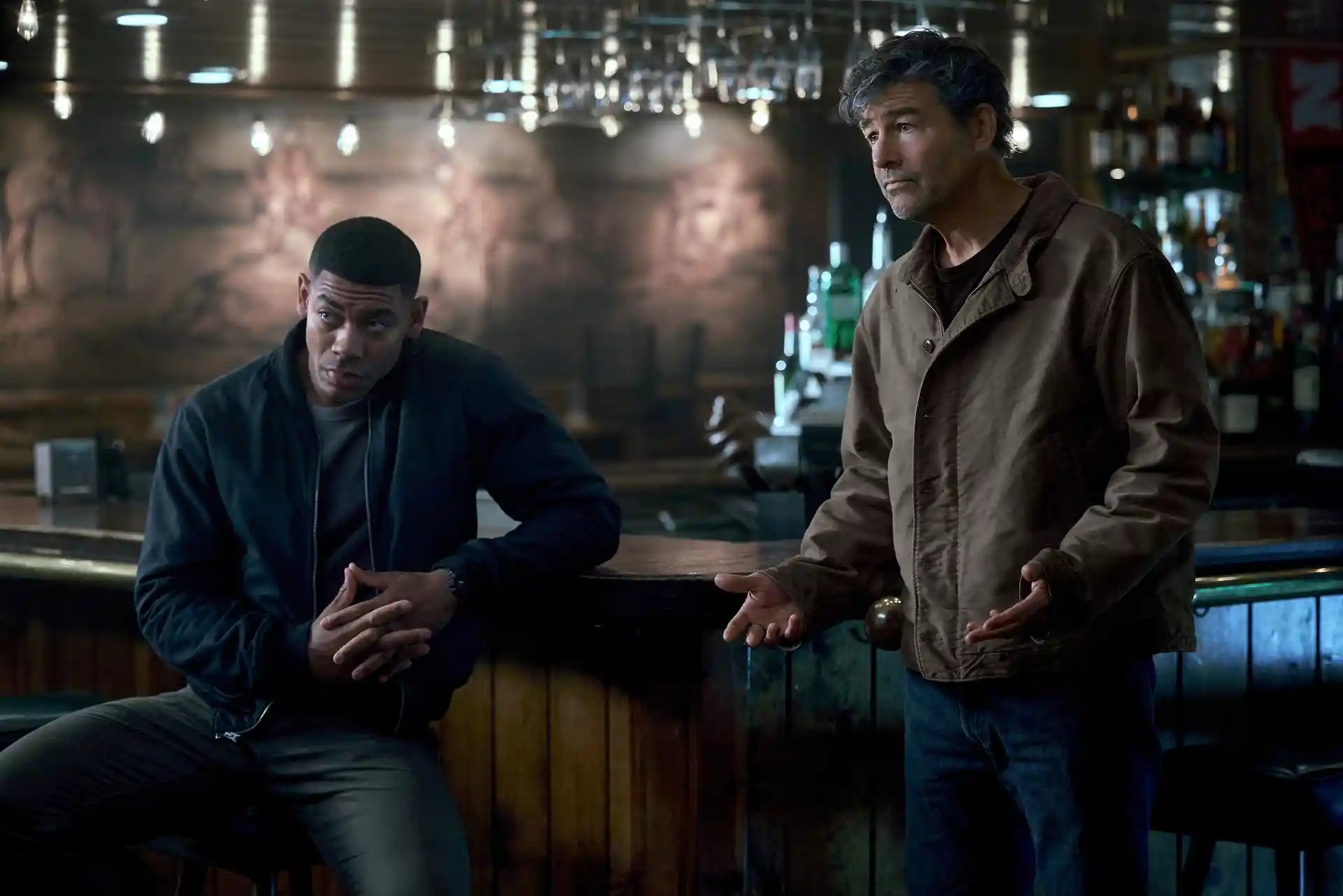
John was created specifically as Hal Jordan’s backup — a role that later stories expanded well past “alternate.” Credit: HBO Max.
The Marine Corps background came later
Here’s a detail worth being precise about: John Stewart was not written as a Marine in 1971. That came from a later retcon, layered on top of the architect background rather than replacing it — current continuity generally treats him as someone who served before pursuing architecture, giving him both a military and a design background rather than picking one. It’s a good example of how much of what casual fans assume is “always been true” about a character actually accumulated over decades of different writers.
What has stuck since the beginning is his refusal to wear a mask. Hal, Kyle and Guy all conceal their identities to some degree; John generally doesn’t, which was a pointed choice in 1971 and has stayed part of the character since — a Green Lantern uninterested in hiding who he is.
From alternate to one of DC’s central Lanterns
“Alternate” undersells what John became. He’s the third human to hold a ring, and across decades of stories he’s repeatedly ended up as Earth’s primary or sole active Green Lantern rather than Hal’s backup — including extended stretches when Hal himself was out of the picture entirely. He’s led the Green Lantern Corps in a tactical capacity often described as among the sharpest in the entire Corps, not just among humans.
That reputation isn’t uncomplicated. One of the character’s most significant stories, 1988’s Cosmic Odyssey, has John fail to defuse a bomb on the planet Xanshi because it had been deliberately painted yellow — a color his ring couldn’t affect at the time. The planet is destroyed. The guilt from that failure follows the character for years afterward and remains one of the more serious, unresolved-feeling low points DC has given any Green Lantern. It’s not the kind of beat a screen adaptation is obligated to include, but it’s part of why John reads as a heavier, more self-critical character than a simple “backup who got promoted” summary suggests.
What Lanterns Episode 3 actually changes
Lanterns Episode 3, “OutKast,” which aired August 30, doesn’t touch the architecture or the construct style. What it rewrites is everything about how John gets to the ring in the first place — and none of it comes from the comics.
In the show, the ring approaches John’s father, John Stewart Sr., years before it ever reaches Hal, and rejects him after he admits his fear. John’s mother, Bernadette, responds by negotiating directly with a Guardian and deciding, with John Sr., to raise their infant son to be fearless enough that the ring could never reject him the way it rejected his father. The training gets genuinely extreme on screen — a widely discussed scene has young John shoot an apple off his father’s head. As an adult Marine, John’s own career gets derailed when Hal captures a target John had spent months tracking, a professional humiliation the comics never depicted playing out between the two men that way.
Episode writer Vanessa Baden Kelly addressed the change directly in an August 30 interview with TheWrap. Her reasoning starts from a real gap in the source material: “There was so much lore surrounding Hal’s backstory, but John’s was a little thin.” From there, she said the writers’ room built the episode around a specific question — “what [does it mean] to be a Black man and get that ring when other characters canonically had it” — landing on the idea that, in her words, “a Black superhero has to do more to be accepted in that world.” Co-creator Damon Lindelof has separately described treating established canon “like plutonium,” while arguing that following it too strictly left “no fun and creativity and originality” in adapting a character whose comic backstory was, by the writers’ own account, underdeveloped compared to Hal’s.

John’s Marine service is one of the few threads Lanterns shares with the comics — though how he gets there is entirely new. Credit: HBO Max.
None of that childhood material is comic canon, and nothing about it has been confirmed as permanent DCU continuity beyond this show. It’s a deliberate, explained creative choice for this adaptation, not a retelling of a story Green Lantern readers already know. For the full breakdown of the episode and how critics and viewers have responded to it, see our Lanterns Episode 3 reaction coverage.
Where this leaves the character
Strip away the show’s new backstory and the throughline is still there: John Stewart has always been the Green Lantern defined by what he builds, not just what he’s given. The comics gave him an architect’s discipline and, eventually, a soldier’s history layered on top of it. Lanterns is telling its own story about how he got to that ring — but the ring itself, and what he does with it once he’s holding it, is still recognizably the character O’Neil and Adams put on the page in 1971.
For more on the wider Green Lantern mythology, see our guides to every Lantern Corps in DC’s emotional spectrum and what to watch before starting Lanterns. For the show’s full cast and schedule, see our complete Lanterns guide, and for how John stacks up directly against Hal Jordan, see our Hal Jordan vs. John Stewart breakdown.
Sources
Make Red Reactions a preferred source
Choose Red Reactions as a preferred source in Google Search.
Confirm your choice on Google.
Related coverage
Lanterns: Hal Jordan and John Stewart Explained — Their Powers, Differences and DCU Roles
Hal Jordan is the reckless veteran; John Stewart is the disciplined recruit. Here's how the two Green Lanterns differ in the comics, what HBO's Lanterns confirms about their dynamic, and how their construct styles actually work.

Do You Need to Watch Anything Before Lanterns? DCU Watch Guide
You can start HBO's Lanterns without watching another DC project. Here's what is actually useful, what is optional, and which older Green Lantern stories you can skip.

James Gunn Called Lanterns Episode 3 'One of the Best' — John Stewart's New Origin Is Dividing Viewers
OutKast reveals how John's parents and the Guardians prepared him for the ring. What the interview, childhood tests and military fallout mean for his new origin.
Lanterns Finale Explained — Who Killed Hal Jordan, John's New Oath and Sinestro's Lantern
Dirt and Stars resolves Hal Jordan's murder and gives John Stewart a different Green Lantern path. The Episode 8 ending explained, including Noah and Sinestro.
About the author
Aram Anwar
Founder & Editor
Aram Anwar founded Red Reactions and writes across comics, gaming, movies and television. His work includes franchise guides and large Lore / Explained features, with an emphasis on separating confirmed details from reports, theory and speculation.
Coverage: Comics · DC & Marvel · Gaming · Movies & TV · Lore / Explained · Guides
More from Aram Anwar