feature · comics
DC/Marvel Crossover Reading Order: From Superman vs. Spider-Man to JLA/Avengers and the 2026 Crossovers
The practical DC/Marvel crossover reading order: the original 1976 team-up, DC vs. Marvel, Amalgam Comics, JLA/Avengers, and the 2025–26 revival, organized by era instead of one invented continuity.
 By Aram Anwar11 min read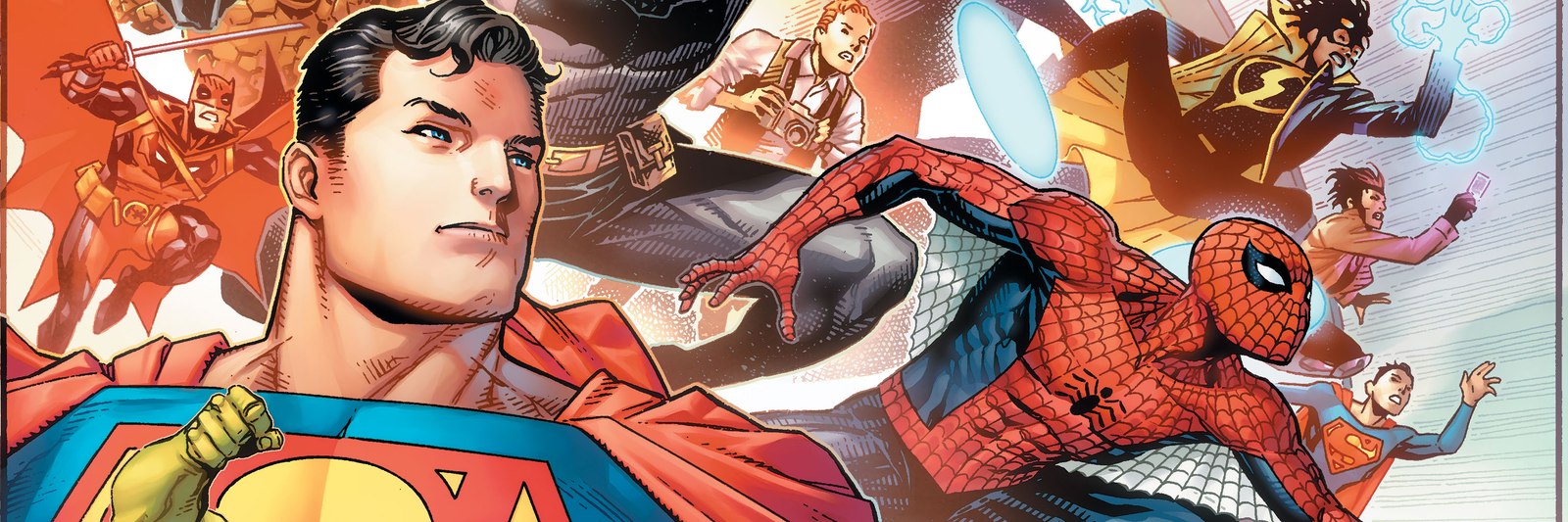
There is no single DC/Marvel storyline you can read start to finish. That’s the confusion this guide exists to clear up: search “DC Marvel crossover reading order” and you’ll find lists that quietly imply one continuous continuity connecting a 1976 treasury edition to a 2026 one-shot. It doesn’t exist. What exists instead is roughly fifty years of separate, mostly standalone team-ups, one real shared event (1996’s Amalgam experiment), one genuine capstone crossover (2003’s JLA/Avengers), a two-decade gap, and a new wave of crossovers running right now.
You don’t need to read all of it, and you definitely don’t need to read it as one story. Here’s how it actually breaks down.
Era 1: The Original Crossovers (1976–2000)
The whole thing started with Superman vs. The Amazing Spider-Man: The Battle of the Century, an oversized treasury edition co-published by DC and Marvel and released in early 1976. Gerry Conway wrote it; Ross Andru penciled it with finishes and redraws from a team that reportedly included Neal Adams and John Romita Sr. on specific pages, inked by Dick Giordano. It’s the first modern superhero intercompany crossover, and DC and Marvel have treated its 50th anniversary as the excuse for the current 2025–26 wave.
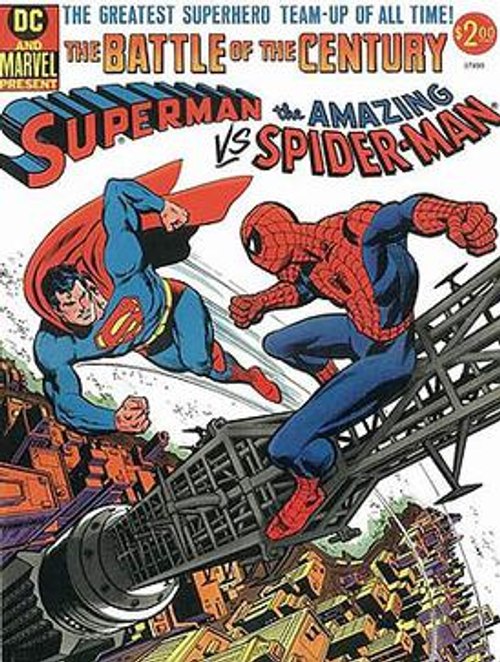
The book that started it all: Superman vs. The Amazing Spider-Man, 1976. Credit: DC / Marvel.
After that, DC and Marvel kept crossing over sporadically for the next 24 years, almost always as standalone one-shots rather than connected chapters:
- DC Special Series #27: Batman vs. The Incredible Hulk (1981)
- The Uncanny X-Men and The New Teen Titans (1982) — Chris Claremont and Walt Simonson’s “Apokolips… Now,” a prestige one-shot with Len Wein serving as DC’s liaison on the project
- Batman/Punisher: Deadly Knights (1994) and its companion volume
- Spider-Man and Batman (1995) and the later Batman/Spider-Man (1997)
- Green Lantern/Silver Surfer: Unholy Alliances and Silver Surfer/Superman (both 1995)
- Batman & Captain America (1996)
- Superman/Fantastic Four: The Infinite Destruction (1999)
- Batman/Daredevil: King of New York (2000)
None of these require reading each other. They’re encounters, not a serialized plot. DC’s own DC Versus Marvel Omnibus, which reprinted most of this material starting in 2024, is a useful shopping guide — but its table of contents isn’t a reading order, and neither is this list beyond “these are the notable ones and roughly when they happened.”
Era 2: DC vs. Marvel / Marvel vs. DC (1996)
This is the one real four-issue event of the era, and it’s where “continuity” briefly became relevant. Ron Marz and Peter David wrote it, with art by Dan Jurgens and Claudio Castellini. The publishing split alternated by issue: DC published #1 as DC vs. Marvel, Marvel published #2 and #3 as Marvel vs. DC, and DC published #4, again as DC vs. Marvel.
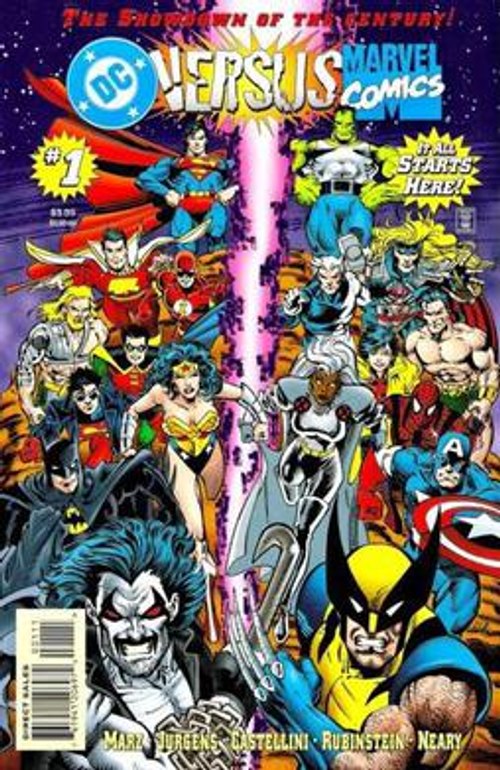
DC vs. Marvel #1 — the start of the only real four-issue DC/Marvel event before JLA/Avengers. Credit: DC / Marvel.
The premise: cosmic entities representing each publisher’s universe stage a tournament of matchups to decide which reality survives. Eleven fights happened across the miniseries; six were decided by the writers (Aquaman beat Namor, Elektra beat Catwoman, Flash beat Quicksilver, Robin beat Jubilee, Silver Surfer beat Green Lantern, Thor beat Captain Marvel), and five were put to a genuine reader vote distributed through comic shops — Superman over Hulk, Spider-Man over Superboy, Batman over Captain America, Wolverine over Lobo, and Storm over Wonder Woman all went Marvel’s way. The event resolves with the two universes’ cosmic embodiments choosing reconciliation over annihilation, which is the direct setup for the next era.
Era 3: Amalgam Comics (1996–1998)
Instead of one universe simply winning, DC and Marvel fused into a single hybrid reality: Amalgam Comics, built from characters that combine one hero from each company. The best-known examples are Dark Claw (Batman + Wolverine), Super-Soldier (Superman + Captain America), Iron Lantern (Iron Man + Green Lantern), Spider-Boy (Spider-Man + Superboy) and Doctor Strangefate (Doctor Strange + Doctor Fate + Professor X).
There were two separate Amalgam waves, and you don’t need either one to follow DC vs. Marvel:
- First wave (April 1996): Twelve simultaneous one-shots — six published by each company — released between issues #3 and #4 of DC vs. Marvel. This is the wave that includes Legends of the Dark Claw and Speed Demon.
- DC/Marvel: All Access #1–4 (December 1996–February 1997): A DC-led sequel miniseries that expanded the Amalgam concept further.
- Second wave (June 1997): Another twelve one-shots, six per company, this time without an accompanying crossover event.
- Unlimited Access #1–4 (December 1997–March 1998): A Marvel-led sequel miniseries that wrapped up the initiative.
If you want the flavor of Amalgam without committing to all 24 one-shots, Legends of the Dark Claw #1 and Doctor Strangefate #1 are the two most frequently cited as the strongest standalone reads. Treat the rest as optional depth, not required homework.
Era 4: JLA/Avengers (2003–2004)
This is the classic era’s actual capstone — a four-issue, fully painted event from writer Kurt Busiek and artist George Pérez that both companies still treat as a genuine high point of the collaboration.
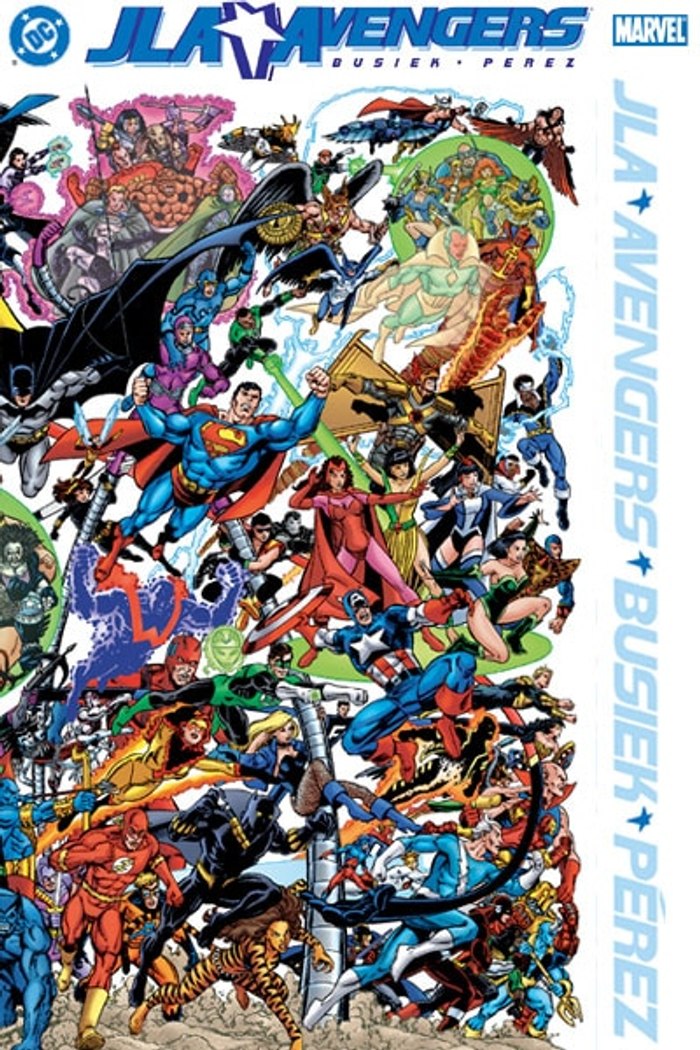
JLA/Avengers: the four-issue Busiek/Pérez event still considered the classic era’s capstone. Credit: DC / Marvel.
The issue naming alternates publishers just like the 1996 event did:
- JLA/Avengers #1 — DC
- Avengers/JLA #2 — Marvel
- JLA/Avengers #3 — DC
- Avengers/JLA #4 — Marvel
Running from September 2003 to March 2004, it’s a full multiversal crossover in which the two teams’ universes literally interact, with Pérez’s art packing in enormous numbers of characters from both companies’ histories.
Is it canon? That question doesn’t have a clean yes-or-no answer, and any guide that gives you one is oversimplifying. Within its own pages, the crossover is presented as a real, in-story event — not a dream or an imaginary tale. For a period afterward, both companies referenced it: DC’s Krona-derived “cosmic egg” element turned up again in later Justice League stories, and Marvel referenced it in its own handbook material. But DC and Marvel have each rebooted their core continuity multiple times since 2004 — Flashpoint, the New 52, Rebirth, Infinite Frontier and DC’s current Absolute Universe line among them, plus Marvel’s own periodic resets — and neither publisher currently treats JLA/Avengers as something a reader needs for present-day continuity. The practical answer beats the fandom argument here: you don’t need to have read it to understand any current Justice League or Avengers comic. It’s a complete, satisfying story that stands on its own, not a prerequisite.
Era 5: The Long Hiatus (2004–2024)
After JLA/Avengers wrapped, new intercompany crossover material largely stopped for roughly two decades. Neither publisher has ever gone on record describing this gap as the result of a lawsuit, formal dispute or ban — that’s an assumption some fan write-ups repeat without a source, and this guide isn’t going to manufacture one. What is documented is that DC and Marvel spent 2024 jointly reprinting the earlier material as new omnibus editions — the DC Versus Marvel Omnibus and its companion DC/Marvel: The Amalgam Age Omnibus — which is useful mainly as availability context: it’s why most of Era 1 through Era 3 became easy to buy again right before the current revival started.
Era 6: The 2025–26 Revival
This is the part that needs to be current as of publication, because the naming gets genuinely confusing.
| Era | Title | Original date | Publisher | Essential? | Notes |
|---|---|---|---|---|---|
| 6 | Marvel/DC: Deadpool/Batman #1 | Sept. 17, 2025 | Marvel | Recommended | Anthology one-shot; six stories by Zdarsky, Thompson, Smith, Ewing, Miller, North |
| 6 | DC/Marvel: Batman/Deadpool #1 | Nov. 19, 2025 | DC | Recommended | Not the same book — different stories, different publisher, main cover by Dan Mora |
| 6 | The Flash/Fantastic Four | Nov. 2025 | DC (digital, DCUI) | Optional | Digital-first, DC GO! vertical-scroll webcomic |
| 6 | Thor/Shazam! | Nov. 2025 | Marvel (digital, Marvel Unlimited) | Optional | Digital-first Infinity Comic by Al Ewing and Jethro Morales |
| 6 | 50th Anniversary Treasury Edition: Superman vs. The Amazing Spider-Man Facsimile #1 | Jan. 7, 2026 | DC | Optional | Facsimile reprint of the original 1976 book |
| 6 | DC and Marvel Present: Superman and Spider-Man Treasury Edition #1 | Feb. 4, 2026 | DC | Optional | Facsimile reprint of Marvel Treasury Edition #28, the era’s other 1976 printing |
| 6 | DC/Marvel: Superman/Spider-Man #1 | March 25, 2026 | DC | Essential | Eight new stories, Mark Waid/Jorge Jiménez among the contributors |
| 6 | Marvel/DC: Spider-Man/Superman #1 | April 22, 2026 | Marvel | Essential | Lead story by Brad Meltzer/Pepe Larraz; Luthor and Osborn team up as the villains |
Publisher direction matters more than it looks like it should. Deadpool/Batman (Marvel-published, Sept. 2025) is not the same comic as Batman/Deadpool (DC-published, Nov. 2025) — different creative teams, different anthology stories, released two months apart. Same split with Superman/Spider-Man (DC, March 2026) versus Spider-Man/Superman (Marvel, April 2026). Don’t assume a similarly named issue from the other publisher repeats the same story; each is its own book.
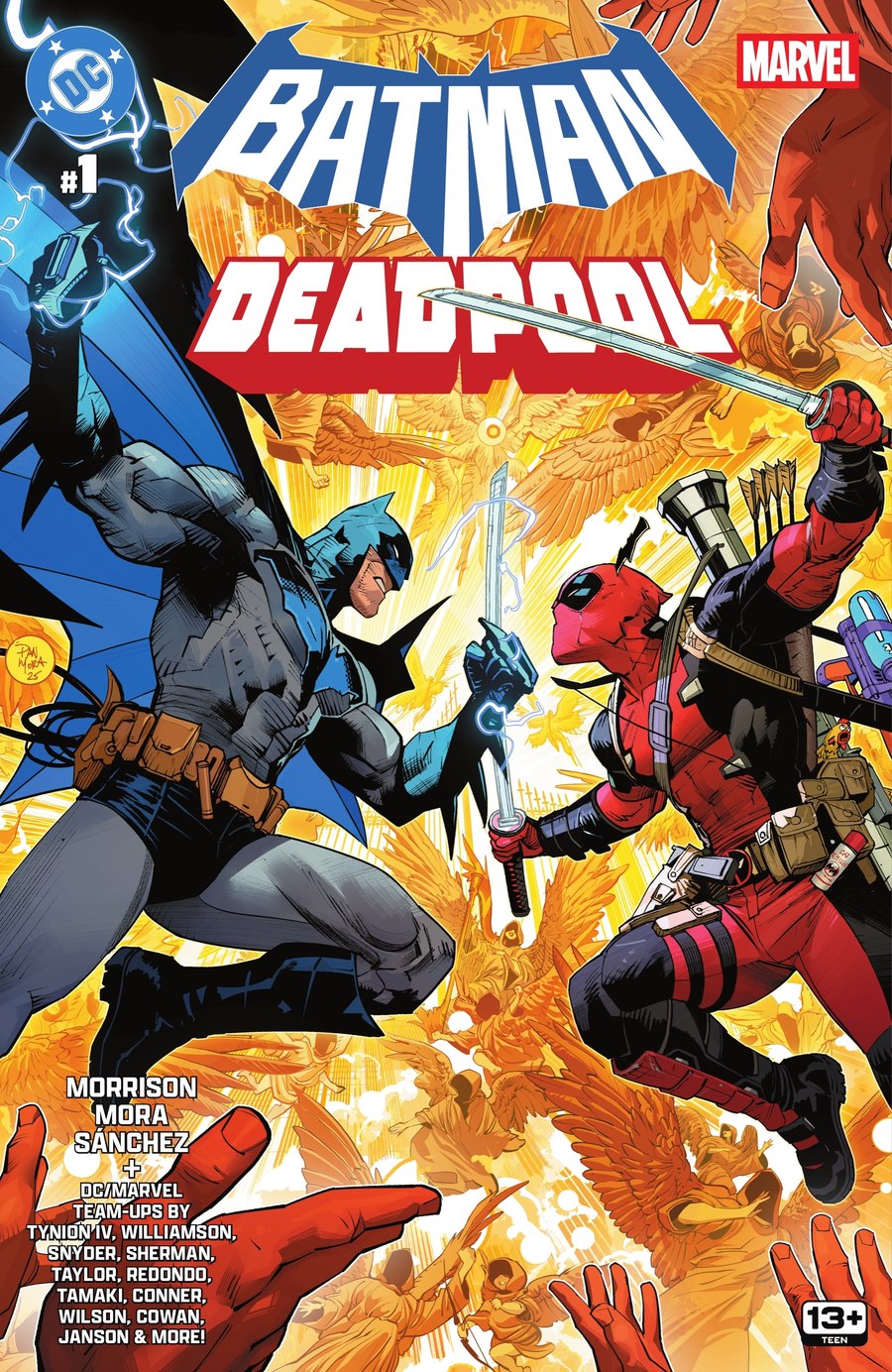
DC/Marvel: Batman/Deadpool #1 — not the same book as Marvel’s Deadpool/Batman #1 from two months earlier. Credit: DC / Marvel.
Can you start with just the 2025–26 books? Likely yes. These are written as self-contained anthology one-shots and single-issue team-ups aimed at readers who have never touched the older material — none of them assume you’ve read the 1996 event, Amalgam or JLA/Avengers. The older crossovers add history and context, not prerequisites.
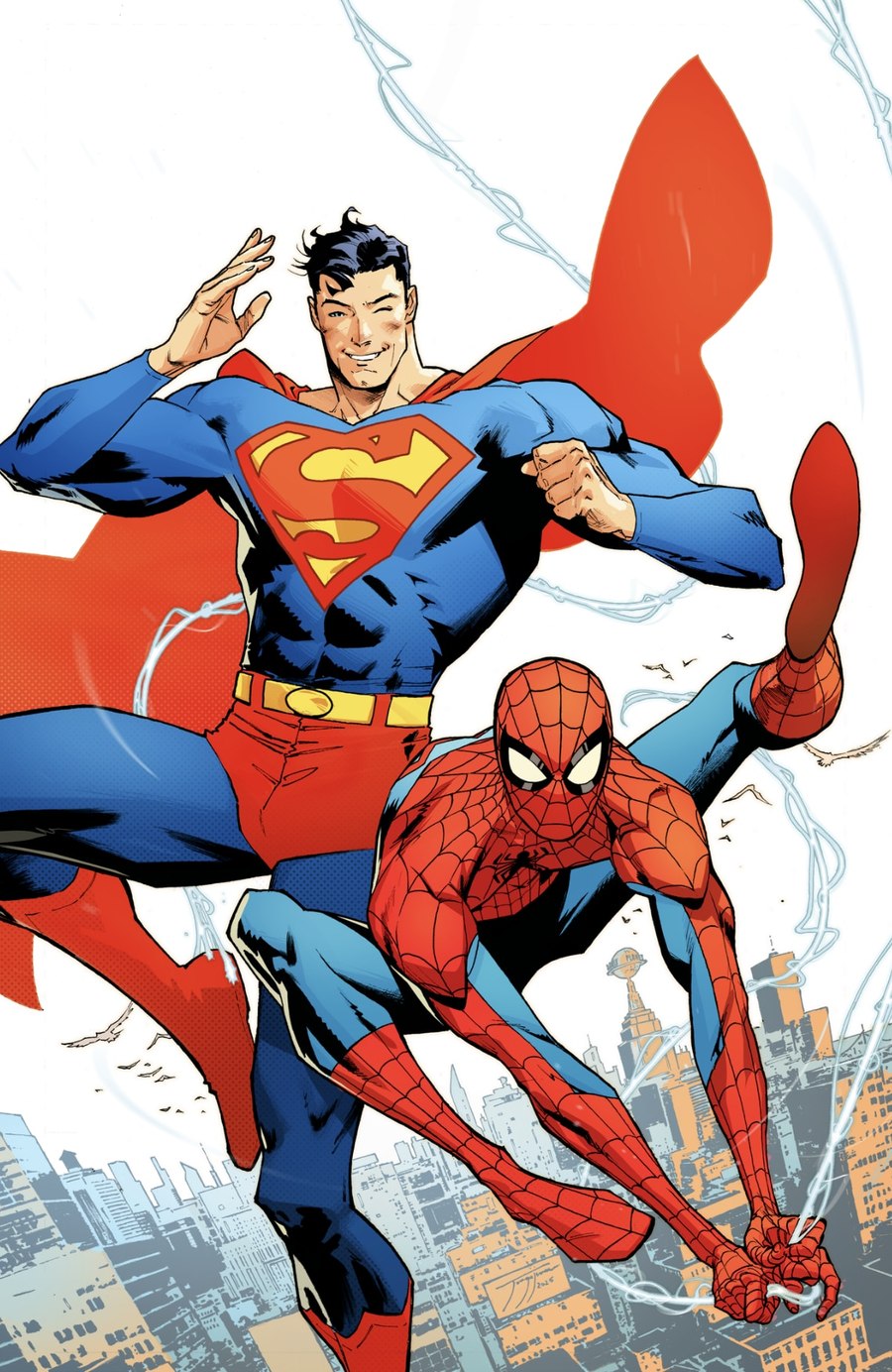
DC/Marvel: Superman/Spider-Man #1, one of two new 2026 one-shots timed to the 1976 team-up’s 50th anniversary. Credit: DC / Marvel.
DC/Marvel: The Cosmic Kiss Caper & Other Stories
The collected edition tying this wave together is DC/Marvel: The Cosmic Kiss Caper & Other Stories, a 224-page hardcover/paperback with a new Jim Cheung cover. Per DC’s own announcement, it collects:
- DC/Marvel: Batman/Deadpool #1
- DC/Marvel: Superman/Spider-Man #1
- The first print edition of DC/Marvel: The Flash/Fantastic Four
- The first print edition of DC/Marvel: Supergirl/Blade
It does not collect Marvel-published material — Deadpool/Batman, Spider-Man/Superman and Thor/Shazam! remain available only through Marvel’s own issues and collections, not this book. Don’t assume “Cosmic Kiss Caper” is a complete 2025–26 anthology; it’s specifically the DC-published side of the initiative, plus the two digital-first stories that happened to be DC-branded.
On the release date: there’s a real discrepancy worth flagging rather than smoothing over. DC’s own June 1, 2026 press release lists the book as arriving September 8, 2026. Penguin Random House’s product listing for the same ISBN currently shows September 15, 2026. Both are live as of this writing. The most likely explanation is the common comics-industry split between direct-market (comic shop) release dates, which DC controls and typically lists first, and book-trade release dates through distributors like PRH, which often land a week or so later — but neither source states that explicitly for this title, so treat it as an open discrepancy rather than a confirmed explanation. If you’re ordering through a comic shop, expect the earlier date; if you’re ordering through a bookstore or online retailer using PRH’s listing, expect the later one.
Two Practical Routes
The complete/historical route
If you want to read through the entire history in publication order: Superman vs. The Amazing Spider-Man (1976) → a couple of representative Era 1 crossovers of your choice (Uncanny X-Men and New Teen Titans is the strongest) → DC vs. Marvel / Marvel vs. DC (1996) → Legends of the Dark Claw and Doctor Strangefate from the first Amalgam wave → JLA/Avengers #1–4 (2003–04) → Deadpool/Batman (2025) → Batman/Deadpool (2025) → Superman/Spider-Man (2026) → Spider-Man/Superman (2026) → The Cosmic Kiss Caper for the DC-side collection.
The essential beginner route
If you just want the highlights without the completionist tour: Superman vs. The Amazing Spider-Man → DC vs. Marvel → JLA/Avengers #1–4 → the four 2025–26 one-shots (Deadpool/Batman, Batman/Deadpool, Superman/Spider-Man, Spider-Man/Superman). That’s seven single-format reads, none of which requires the others, and it covers every genuinely significant chapter of this history.
The Short Version
DC and Marvel have crossed over on and off for fifty years, almost always in standalone bursts rather than one connected story. The 1996 event and Amalgam experiment are linked to each other; JLA/Avengers is its own separate capstone; the 2025–26 wave is a fresh initiative built to work for readers who have read none of the above. Pick an era that interests you and start there — you’re not missing a hidden throughline by skipping the rest.
If you’re also tracking DC’s other current reading-order questions, our DC Absolute Universe reading order covers the separate 2024–26 Absolute line — worth flagging specifically because it’s unrelated to anything in this guide. The Absolute Universe is its own standalone DC reality, built around Darkseid altering DC’s own timeline, with no connection to Marvel or to any of the crossovers above.
Sources
Make Red Reactions a preferred source
Choose Red Reactions as a preferred source in Google Search.
Confirm your choice on Google.
Related coverage
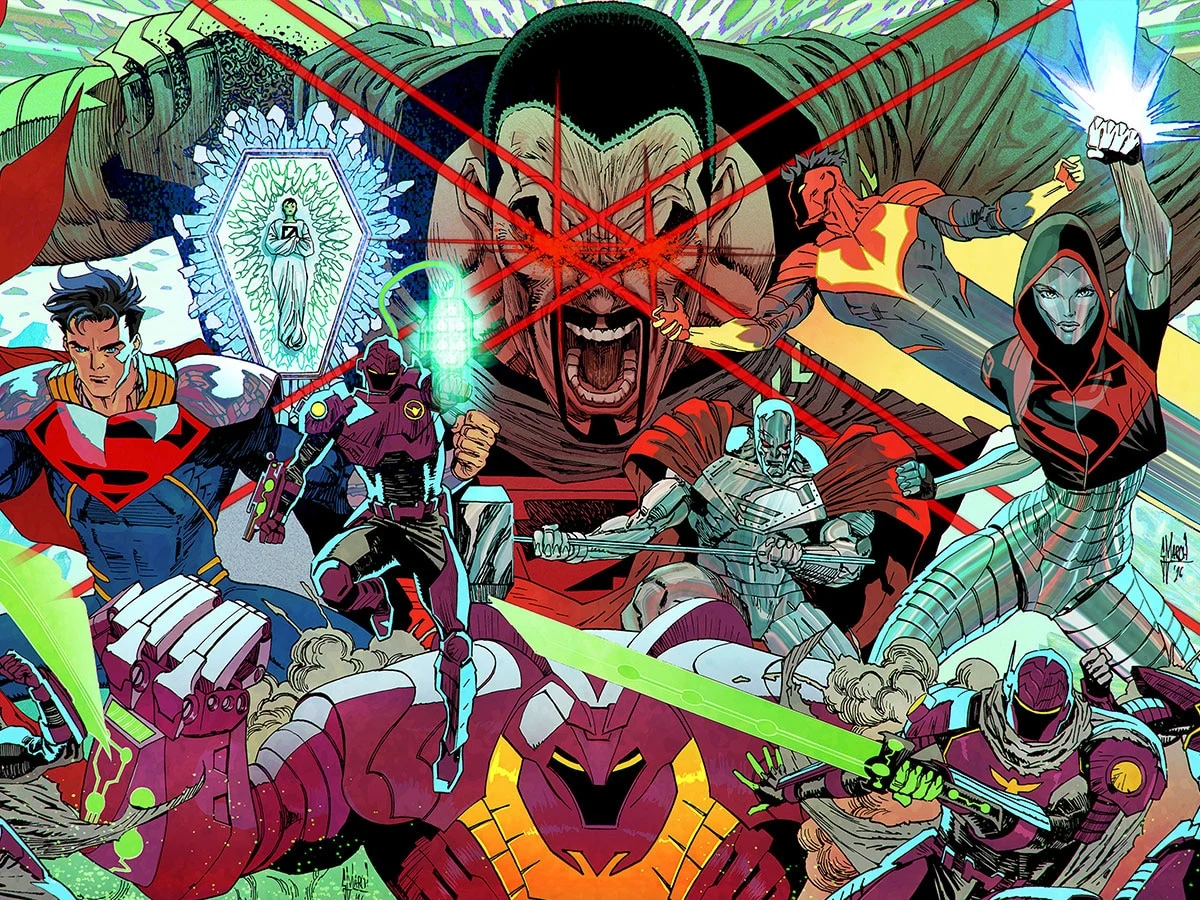
Kingdom of Zod Reading Order — Every Superman, Supergirl and Action Comics Chapter in Order
The complete, verified reading order for DC's Kingdom of Zod crossover: which Supergirl, Action Comics, Superman Unlimited and Superman issues are required, what's just useful setup, and where the collected edition fits.
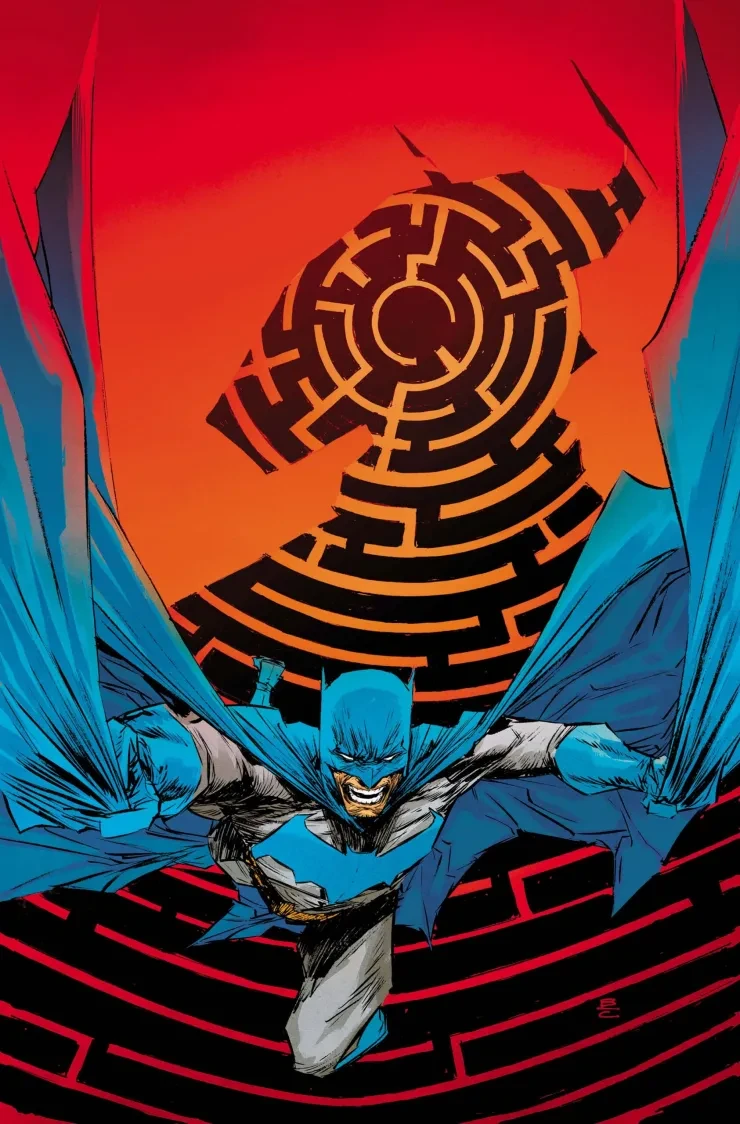
DC November 2026 Solicitations: Batman #15 Targets Bruce Wayne, Gangs of Gotham Debuts
DC's November 2026 solicitations put Bruce Wayne in the crosshairs in Batman #15, launch Gangs of Gotham, and set up major turns for Superman and the Justice League.
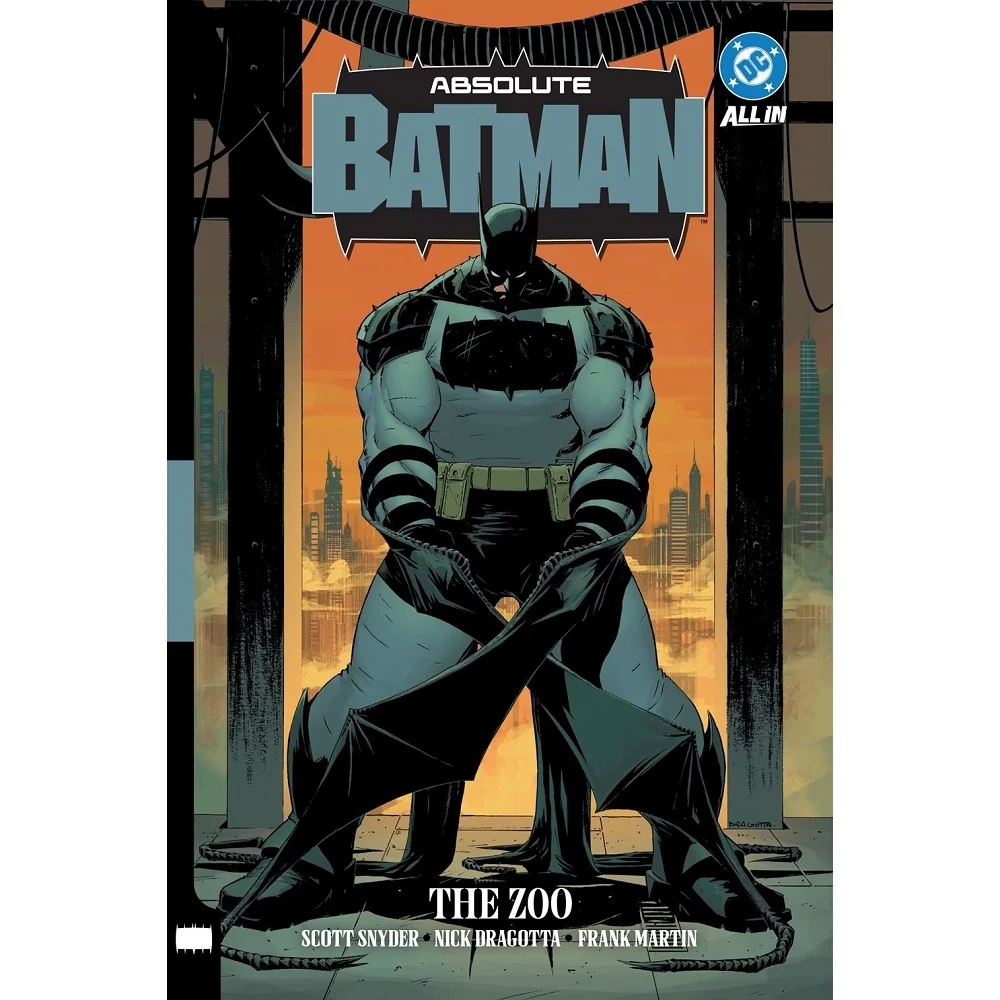
DC Absolute Universe Reading Order: Where to Start With Batman, Superman, Wonder Woman and More
The practical DC Absolute Universe reading order for 2026: where to start, which books connect, what is optional, and the easiest collected-edition route.
Batman: Justice Year Brings Joshua Williamson and Bruno Redondo Together in 2027
Batman: Justice Year is coming in 2027 from Joshua Williamson, Bruno Redondo and Adriano Lucas. Here's the reported Justice League premise and what remains unannounced.
About the author
Aram Anwar
Founder & Editor
Aram Anwar founded Red Reactions and writes across comics, gaming, movies and television. His work includes franchise guides and large Lore / Explained features, with an emphasis on separating confirmed details from reports, theory and speculation.
Coverage: Comics · DC & Marvel · Gaming · Movies & TV · Lore / Explained · Guides
More from Aram Anwar