lore · comics
Mister Sinister Explained: Origin, Powers and X-Men History
Nathaniel Essex, Apocalypse, the Marauders, Madelyne Pryor, Cable, Krakoa and Sins of Sinister — the full story of the X-Men's coldest villain, and why killing him never sticks.
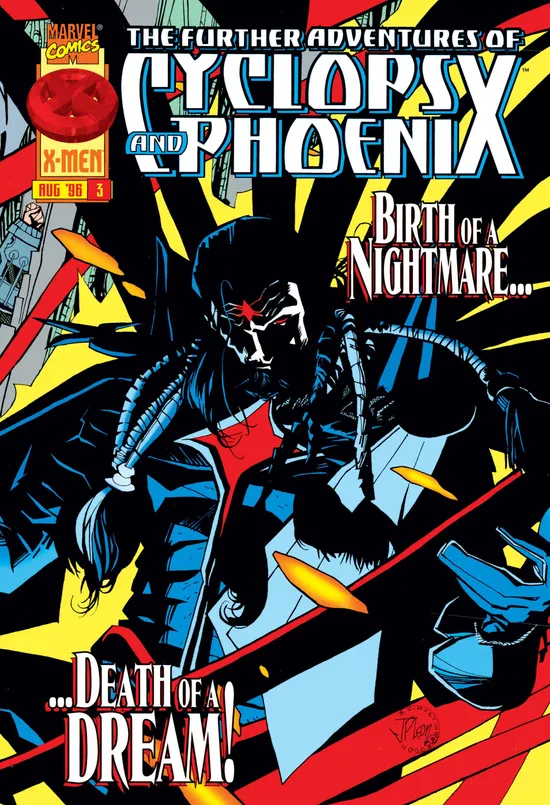
There is a version of Mister Sinister that exists purely to be looked at. Bone-white skin, red eyes, a diamond stamped on his forehead, a cape with a collar you could park a bicycle behind. He arrives in a room like a man who has rehearsed arriving in rooms. Half the fun of him, across forty years of X-Men comics, is that he is spectacularly, unapologetically extra.
The other half is that none of it is the scary part.
Strip away the theatre and Nathaniel Essex is a man with a filing system. He keeps samples. He keeps records. He watches a family for three generations because the interesting result might not appear until the third. When he looks at Scott Summers he does not see a rival or even a person; he sees an unusually promising set of alleles that has unfortunately been allowed to make its own decisions. Magneto wants mutants to survive. Apocalypse wants them to prove they deserve to. Sinister wants a clean data set, and he has never once been troubled by what he has to do to people to get one.
The scientist who dug up his own son
Marvel’s account of Essex begins in Victorian London, where a gifted young biologist read Darwin and decided the great man had been too polite about his own conclusions. Essex believed evolution was already happening in humanity, driven by something he called the Essex Factors: untapped genetic potential that would eventually produce a new kind of person entirely.
He was right, which is the tragedy of him. He was also, by then, well past the point of caring how he proved it.
The turn came from grief. Essex and his wife Rebecca had a son, Adam Stanislaus Essex, who died of birth defects. Another man might have been softened by that. Essex went the other way, deciding that mortality was a design flaw and he was the one to correct it. He presented his theories to the Royal Society alongside a cadaver he had assembled from human and animal remains, which went about as well as you would imagine. Ousted and unbothered, he hired a gang of criminals, the first Marauders, to bring him deformed people to experiment on, and exhumed Adam’s body to continue his work. Rebecca, watching her husband become something she had no vocabulary for, pulled away.
Apocalypse found him at exactly the right moment. En Sabah Nur had been observing this strange Englishman who understood mutation before mutation had a name, and he made an offer: partnership, and a share in the future. Essex hesitated. He went home instead, and swore to rededicate his life to Rebecca and the child she was carrying.
Both of them died in a premature birth. Rebecca refused his apology with her last breath, and the word she used for him — sinister — is the one he kept.
What happens next is documented in Further Adventures of Cyclops & Phoenix #3, a 1996 miniseries by Peter Milligan and John Paul Leon that sent Scott Summers and Jean Grey back to 1859 to watch it happen. Marvel’s own summary of the issue is blunt: Essex forms his alliance with Apocalypse, Apocalypse transforms him, and Mister Sinister is born.
He was not a loyal servant for long. Apocalypse ordered him to engineer a plague; Sinister built a techno-virus instead and infected Apocalypse with it. That is the pattern for everything that follows. He takes the gift, keeps the gift, and starts looking for the exit the same afternoon.
Readers met the monster nine years before the man
None of that Victorian backstory existed when Sinister first turned up. He was built the other way round, as a shadow with an agenda.
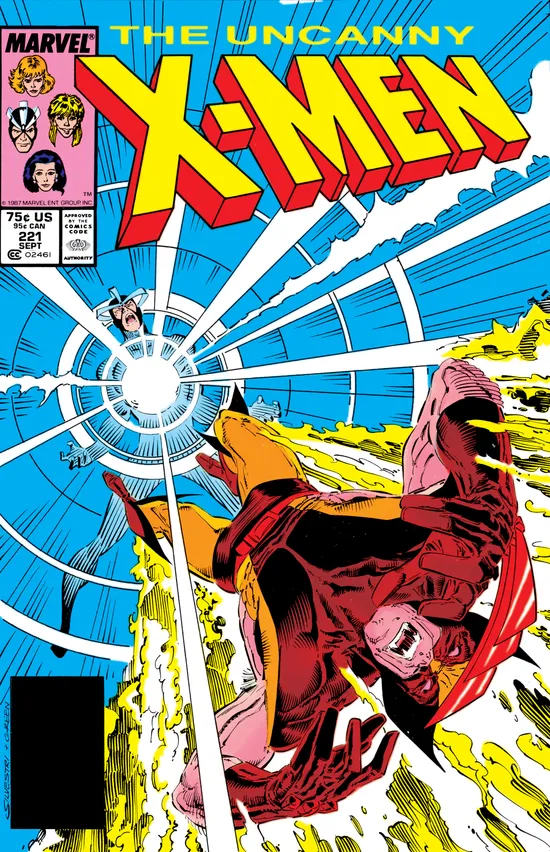
Marvel identifies Uncanny X-Men (1963) #221, published in September 1987, as his first full appearance. It is a Chris Claremont and Marc Silvestri issue in which the X-Men are trying to protect Madelyne Pryor from a squad of killers, and a pale man in a cape is clearly enjoying himself somewhere off-panel. It took until Uncanny X-Men #227 for him to step forward as the mastermind behind the Marauders. The 1859 origin arrived nearly a decade later.
That sequencing matters to how the character reads. By the time Marvel explained him, he had already done the worst thing he would ever do.
The Mutant Massacre ran through the X-books in late 1986, and it is still the crossover the X-Men flinch away from. Sinister sent the Marauders into the tunnels under Manhattan to exterminate the Morlocks, a community of mutants whose entire crime was being visibly different and wanting to be left alone. The X-Men and X-Factor arrived too late and too few. Several of them came out permanently damaged.
The motive is the coldest part. Sinister had discovered that his research had been stolen and misapplied by the Dark Beast, a refugee scientist from the Age of Apocalypse who had spent twenty years experimenting on people in secret. Some of the Morlocks were the result. As Marvel’s history of the Morlocks puts it, Sinister recognised his own handiwork in them and had them wiped out. It was not hatred. It was a lab technician noticing contamination and sterilising the sample.
Gambit, who had helped assemble that incarnation of the Marauders without knowing what they were for, walked out of Sinister’s service over it and has been carrying it ever since.
The Summers experiment
Everything Sinister has done to the Summers family follows from a single conviction: a child of Scott Summers and Jean Grey would be the most powerful mutant ever born, and he intended to own the process that produced them.
He started when Scott was a child. Sinister ran an orphanage, the State Home for Foundlings in Sage, Nebraska, for decades, shaping the development of the children inside it. When he learned about the Summers brothers, he drugged the hospitalised Scott into looking comatose so both boys could be transferred into his care, then arranged for Alex to be adopted away while keeping tabs on him. He tested Alex’s powers by provoking a bully into attacking him, then buried the ability under a mental block. He experimented on Scott for a year and buried the memory of it. He posed as a fellow orphan named Nate to stay close. When a family tried to adopt Scott, Sinister arranged a fatal accident for them.
He also gave Scott the ruby quartz glasses. The single most defining object in Cyclops’s life is a gift from the man who decided he could not be allowed to control his own power.
Then Xavier got to him first, and Jean got to him first, and Sinister had to improvise.
When Jean Grey was believed dead after the Dark Phoenix Saga, Sinister used stolen DNA to make a clone, named her Madelyne Pryor, gave her manufactured memories of a life as a pilot, and arranged for her to be working for Scott’s grandparents in Alaska when he came looking for somewhere quiet. Scott met a woman who was the image of everything he had lost. They married. They had a son, Nathan. Sinister watched from the house next door under an assumed name.
It is worth being careful here, because “Jean Grey’s clone” is a phrase that has done Madelyne enormous damage. She was not a device. She was a woman with a life, a marriage and a child, and when she discovered that all of it had been engineered — that Sinister had erased her records and sent the Marauders to kill her once she had served her purpose — she did not quietly exit the story. She became the Goblin Queen during Inferno, powerful enough that her creator could not control her, and she has since spent decades as a character in her own right, up to and including ruling Limbo and leading her own Dark X-Men. The horror of what Sinister did to her is precisely that she was a person.
Their son is Cable, and here one detail gets mangled constantly. Sinister engineered the circumstances of Nathan Christopher Summers’s birth. He is not Nathan’s father, biologically or otherwise. And when Sinister moved to seize the baby, it was Apocalypse who infected the infant with the techno-organic virus — a strike aimed at Sinister’s prize, which forced Scott to send his son two thousand years into the future in the hope that someone there could save him. Nathan came back as a soldier with a metal arm. Two villains, two entirely separate crimes against the same child.
What Mister Sinister can actually do
Sinister is not a mutant in the ordinary sense. He was born human. Marvel’s own profile describes Apocalypse’s transformation as giving Essex the superhuman foundation that allowed him to survive far beyond a normal human lifetime. Sinister then spent the next century and a half treating his own body like another experiment, adding and altering abilities with mutant genetic material. That is why his power set has never been as clean or fixed as Cyclops’ optic blasts or Wolverine’s healing factor.
The recurring package is telepathy, telekinesis, superhuman strength and concussive energy projection, layered on top of total control of his own body at the molecular level. That last one does most of the heavy lifting. It lets him reshape himself into other people, flow around damage rather than absorb it, and rebuild tissue that should have killed him. He acquired those later shape-changing abilities from a cell sample taken from Courier, a shapeshifting mutant he captured in the 1890s and released once he had what he wanted. Marvel’s current listing also includes teleportation, though it surfaces far less often on the page than the rest. The exact starting package is described somewhat differently across Marvel’s official summaries; the later self-directed modifications are why Sinister’s abilities keep changing.
This is why “what are Mister Sinister’s powers” is a slightly wrong question. Cyclops has a power. Sinister has an inventory, and it changes. When the Scarlet Witch depowered most of the world’s mutants on M-Day, Sinister lost most of his borrowed abilities along with them, because they were never his to begin with.
Which leaves the thing that actually makes him formidable, and it has nothing to do with punching. He is a geneticist, a biologist, a surgeon and an engineer of the first rank, with a hundred and fifty years of research and a network of hidden laboratories linked by tesseract technology, all of them stuffed with DNA samples he has been collecting since before anyone knew what DNA was. He can look at a person’s defining biological gift and treat it as a component. Victor von Doom builds machines and dares the universe to admire them; Sinister builds people and does not particularly care whether anyone notices. If you want a sense of how differently two brilliant Marvel villains can wear the same intelligence, our Doctor Doom explainer is a useful companion piece.
Killing him is a scheduling problem
Cyclops has destroyed him with a full optic blast. Mystique shot him in the head. Hope Summers shot him. The Phoenix Force incinerated him along with an entire underground city he had built beneath Alaska and populated with copies of himself. He has been blown apart, burned out and buried more times than most X-Men villains have appeared.
He keeps coming back, and not because he heals.
Wolverine survives because his body repairs itself. Sinister survives because he built an institution. There are spare bodies. There are clones. Claudine Renko, who became Miss Sinister, was created and released into the world with no idea what she was. There was the Cronus device, a failsafe that would activate his encoded genetic material inside other people’s children if he died, which is how Charles Xavier ended up with a piece of Mister Sinister waiting inside him. At one point he ran a small society of himselves out of a stolen Celestial head and cheerfully pointed out that a hive mind cannot be assassinated in any way that means anything.
The molecular control matters here too. Sinister’s body is less a fixed object than a preference. Destroying the one in front of you closes the current incident. It does not close the account.
Krakoa gave him exactly what he wanted
Then the X-Men handed him the keys, on purpose, with a straight face.
When Charles Xavier and Magneto were building the mutant nation of Krakoa, they needed a complete catalogue of the mutant genome. Sinister had spent his entire existence assembling one. The negotiation happens in Powers of X #4, and the scene is a perfect distillation of the character: the Sinister they approach refuses the offer, and is immediately murdered by a second Sinister who is delighted to accept.
His archive became a load-bearing pillar of the Krakoan Resurrection Protocols, the system that let the island bring dead mutants back. In exchange he was seated on the Quiet Council, the body of twelve that governed Krakoa. Nobody involved mistook this for redemption. It was a hostage exchange dressed as diplomacy, and every party knew it.
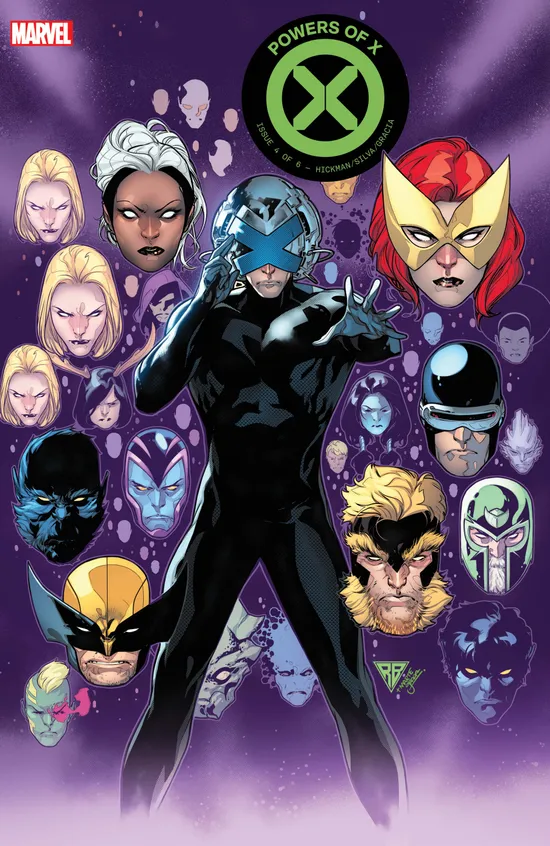
He also gained access to Krakoa’s deepest secret: Moira MacTaggert, whose mutant power reset reality every time she died, restarting her life from birth with her memories intact. Sinister grew clones of her.
What he built from those clones, the Moira Engine, is not time travel, and it is worth resisting the shorthand. He was not driving backwards through history in a machine. He was using someone else’s biology as a save function. Run a plan, watch it fail, kill the correct Moira, and reality restarts from a fixed point with the failure logged and the knowledge preserved. A scientist who had always been willing to spend individual lives on a result could now spend entire timelines on one.
And because he is who he is, he had already sabotaged the resurrection system itself, hiding a copy of his own genetic signature inside every sample he handed over. It never took. Hope Summers, whose powers are central to the resurrection process, kept subconsciously scrubbing it out without ever knowing she was doing it.
Sins of Sinister
Sins of Sinister, the 2023 event by Kieron Gillen and a small army of artists, is what happens when the one obstacle is removed.
Sinister ran his attack on the Quiet Council ten times, resetting after each failure, until he found the version that killed Xavier, Emma Frost, Exodus and Hope. When Krakoa resurrected them, it did so with his tampering intact, and four of the most influential mutants alive came back subtly, invisibly his. He was exiled to the Pit for the attack. It made no difference. His people were already inside the machinery.
From there it compounds the way only bad ideas with infrastructure can. Krakoa starts offering the X-gene to humans as an implant, marketed as immortality, which quietly installs Sinister’s DNA in anyone who takes it. Within a decade he holds most of the planet. Within a century he is engineering Chimeras: mutants built with multiple X-genes and the powers of several people at once, his masterpiece being Rasputin IV, assembled from Colossus, Kate Pryde, Quentin Quire, Unus and Laura Kinney. Within a millennium the story has left the X-Men behind entirely and become a horror about scale.
The goal underneath all of it is Dominion: a state of existence beyond space and time, the endpoint of intelligence, historically reached only by machines. Sinister’s entire century-long project has been a race to get there before an artificial intelligence does, because he is certain that whatever wins will consume everything that did not.
He loses, and he loses in the most fitting way available. His Moira clones are stolen out from under him, stranding him in the future he made with no reset available. His own corrupted lieutenants develop enough free will to stop obeying him. Moira herself tells him, to his face, that he was never going to succeed. The timeline is finally rolled back, his changes to the resurrection protocols are undone, his Quiet Council seat is gone, and he ends the event weaker than he has been in a century — trapped in a universe made entirely of Mister Sinister and finding it unbearable.

There is more than one of him, and always was
The Krakoan era’s last twist reframes the whole biography.
In 1895, facing his own death and convinced that machine intelligence would eventually swallow everything, the original Nathaniel Essex made four clones. Each was given a card suit and a different route to survival, and each was sent out to work the problem alone. Marvel laid the four of them out as the crossover unfolded:
The red diamond is Mister Sinister, who bet on mutants, and who has been in the X-Men’s lives since 1987. The black club is Doctor Stasis, who bet on human and post-human evolution instead, and who despises mutants enough to help run the anti-mutant organisation Orchis. The black spade is Orbis Stellaris, who went to space, became an interstellar arms dealer and bought himself a seat on the Galactic Council. The white heart is Mother Righteous, who took the occult route, trading favours and gifts for faith on the astral plane and assembling a collection of stolen relics.
Four researchers. One question. No collaboration, and a great deal of mutual sabotage.
This is a retcon, and it should be read as one. It was not lurking in the 1987 comics, and the Sinister who tormented Cyclops in the eighties and nineties was written as the article, not a copy. What it changes is smaller and stranger than “the classic stories don’t count.” It means the Sinister the X-Men know has always been a branch of an experiment rather than the whole of it — that the man who treats everyone he meets as a variable was himself created as a variable, by a version of himself, for a result he does not control. He is a hypothesis that woke up. Later stories push that further still, into a Dominion-level intelligence called Enigma assembled from what all four of them learned, but the joke lands perfectly well without it.
This corner of the character keeps resurfacing elsewhere in current X-Men media: our X-Men ‘97 explained guide covers his role in the animated revival, and Phoenix Five explained covers a different, later chapter of the same X-Men continuity.
The part that stays with you
Plenty of Marvel villains want to rule the world. That ambition is almost comforting, because it assumes the world is worth having.
Sinister does not want to rule people. He wants ownership of the process that produces them — of heredity itself, of which combinations get to exist and which get filed. He drugged a boy to steal him. He grew a woman to be someone’s wife. He murdered a community because they were an imperfect copy of his notes. He sat on a governing council of a nation founded on mutant self-determination and used it to put himself inside the bodies of everyone who died there.
The X-Men have always been a story about people insisting that their bodies belong to them. Nathaniel Essex is the villain who read that premise, found it sentimental, and got to work.
Make Red Reactions a preferred source
Choose Red Reactions as a preferred source in Google Search.
Confirm your choice on Google.
Related coverage

Weapon X Explained: How Wolverine Got His Adamantium and Lost His Memories
Weapon X didn't create Wolverine's mutant powers — it bonded adamantium to a skeleton and claws he already had, then tried to erase his mind. Here's what the program actually did, and what came later.
Phoenix Five Explained: Why Cyclops Has the Phoenix Force in Marvel Tōkon
Phoenix Cyclops isn't a new Tōkon invention. Here's the Avengers vs. X-Men story it's based on — why the Phoenix Force split between five mutants, and how Cyclops ended up holding it.

Madripoor Explained: Wolverine's Patch Era, Lowtown and Marvel's Wolverine
Madripoor is Marvel's fictional island port. Explore Hightown and Lowtown, Wolverine's Patch identity, the Princess Bar, and its separate Earth-1048 game version.

X-Men '97 Characters and Powers Explained
Meet the main X-Men '97 characters and learn what Cyclops, Storm, Wolverine, Rogue, Gambit, Magneto and the rest can actually do.
About the author
Sara Avegaard
Movies & TV Writer
Sara Avegaard covers film, television and streaming for Red Reactions. Her archive spans entertainment news, production and release developments, trailer coverage and explainers that put new announcements in context.
Coverage: Movies · TV & Streaming · Entertainment News · Explainers
More from Sara Avegaard